Friday, March 16, 2012

Scarface (1932)

First of all, I'd like to say that this past week marked the first anniversary of my first blog posting. I'd like to thank everyone who has visited my little corner of the Internet, and also thank everyone for their support, kind words, and comments. It's been a lot of fun and hopefully, like a fine wine, the blog has gotten better with age. I'm looking forward to continuing for as long as I can. So now that I've bored you kids with this long-winded sentimentalism, let's start the next year off with a rousing gangster film.

Scarface stars Paul Muni, George Raft, Boris Karloff, Ann Dvorak, and Karen Morley.  The film was released by United Artists and based on the novel by Armitage Trail.  The film was directed by Howard Hawks, produced by Howard Hughes and the screenplay was written by Ben Hecht.

The overall mood of the film is very dark as it chronicles the violent rise, and eventual fall, of a Capone-like Chicago gangster.  The story begins as gang boss Johnny Lovo (Osgood Perkins) persuades rival gangster Tony Camonte (Muni) to make a hit on his own boss, Big Louie Costillo (Harry J. Vejar), who he's supposed to be protecting.  Tony is seen only in shadow and silhouette and happily whistling a tune as he calmly walks up to Big Louie and "plugs him" several times.  The scene briefly reminded me of the Peter Lorre character in "M" (1931) who whistles while he stalks his victims.  In return Lovo promises Tony "a piece of the action" and he also becomes Johnny's second in command.  Camonte is cocky and vicious, sometimes humorous, but most of the time a psychotic thug who lives by only one rule -- "Do it first, do it yourself, and keep on doing it".

We're officially introduced to the Camonte character and his sidekick Guino "Little Boy" Rinaldo (Raft) as the police round up suspects in the Costillo murder case.  We see Camonte's total disrespect for the law when he strikes a match on the sergeant's badge to light a cigarette.  He kills and strong arms his way up the criminal ladder even making a play for Lovo's "girlfriend" Poppy (Morley) who's had her eye on Tony as well.  Success has its drawbacks and a rival gangster named Gaffney (Karloff) plans a hit on Camonte to prevent him from taking over any more territory.

 Gaffney's planning to use a new "persuader" to cut Tony down to size -- a submachine gun that fires "three hundred slugs a minute". The gangs exchange hits and the war between the rivals escalates. Tony catches his sister (Dvorak) with his sidekick "Little Boy" which gives the ending of the film a little unexpected twist. I actually viewed the alternate ending for the film and both endings were both pretty good so it's a toss up for me as to which one was better. Let me just say that justice was served, but in two different ways.

This film actually excels at proving the point that I've tried to make on quite a few occasions, that film makers can get their message across without the need of excessive graphic and gratuitous violence and language.  The film is violent but pretty tame compared to today's standards.  Some viewers believe there's some sort of incestuous affair between Tony and his sister Cesca.  I don't really see it that way.  I see it more as an immigrant family's siblings trying to keep each other safe in a new land.  Tony's affection for his sister does seem a little extreme, but I personally don't see anything that hints at incest.

Muni was incredible and really seemed to be enjoying himself, while Dvorak and Morley are both beautiful and great supporting players.  George Raft looks very comfortable in the type of role he would play many more times.  Karloff was pretty good and looked the part, but his voice just didn't seem to fit.  Every time I heard Karloff's voice I thought "horror" not "gangster".  Typecast?  Yeah ...  pretty much.  He was just really good in horror films.  Karloff appeared in Scarface only one year after his role as "The Monster" in Frankenstein (1931).

According to TCM's film oracle Robert Osborne, the film is of course based on the legendary crime boss of the day Al Capone.  When the film started production a couple of Capone's "associates" visited writer Ben Hecht and asked him if he "really thought it was wise to write a script about Capone". Hecht being a newspaper man from Chicago wasn't intimidated by the henchmen and actually convinced them to become consultants.  The creators of the film also had difficulty getting past the censors because of the violence, and the censorship boards thought that the film "glorified gangsters" (when in fact it was supposed to be an anti-gangster film) and they demanded several changes including the alternate ending.  Howard Hughes who had put a lot of his own money into the film ended up releasing it in states where the censors were a little more lenient.   The result -- very long lines at the box office.

Excellent film, don't miss it ...

Wednesday, February 29, 2012

The Outer Limits - Season One, Episode Twenty-Nine - A Feasibility Study - Original Air Date, April 13, 1964

"There is nothing wrong with your television set ..."

I was pretty certain I had seen every original Outer Limits episode, but for some reason this title didn't bring any images to mind.  But I do have to admit that this is one of the creepiest episodes of The Outer Limits that I've seen.  This episode stars Sam Wanamaker, Phyllis Love, Joyce Van Patten and David Opatoshu.  It's produced and written by Joseph Stefano and directed by Byron Haskin, with music by Dominic Frontiere.

The story begins as an alien spaceship enters the Earth's orbit and teleports an entire neighborhood to the alien's home planet "Luminos" in order to conduct an experiment.  The "Luminoids" are seeking new civilizations to serve as slave labor for their planet.  If the experiment is successful, the entire population of the planet is doomed to be enslaved.

Ralph Cashman (Opatoshu) starts his day with a shot of booze and half a pretzel, and it's off to the office (I think it's actually Sunday) to put in a few hours of work.  After stepping outside for the morning paper, his wife Rhea (Van Patten) tells him about a strange mist outside.  What they don't know is that the mysterious mist and the ominous cloud filled sky that blocks out most of the sunlight conceal strange beings from another planet who are observing the humans. 

Ralph notices his neighbor, Dr. Simon Holm (Wanamaker), having some car trouble and offers to give him a ride into town and drop him off at church.  Ralph sends his wife over to check out the engine problem ("She's one of those housewives who can fix anything") and she quickly discovers the reason.  Ralph drops Holm off and drives into the mist but stops when the visibility becomes too bad to continue.  And in true classic sci-fi style, when things start to go wrong, instead of staying in the relative safety of the vehicle he exits the auto and stumbles into the choking cloud to be pursued by the alien creatures.

When Simon changes his mind about going to church and returns to his house and his wife Andrea (Love), they encounter one of the strange beings.  After realizing what's happening the humans gather together in a church to make a final stand against the alien threat.

With special effects similar to those of a low budget sci-fi film (including a spaceship that looks like a salt shaker on steroids), but probably very costly for a television series at that time, the sets and costumes though relatively cheap looking are very effective.  The director's use of lighting and camera angles give the episode a kind of nightmarish quality that sticks with you.

Lots of people try to compare The Outer Limits with The Twilight Zone, and some prefer one over the other.  I sat here for a while and tried to decide which I liked better and it's really a tough call.  I can't really say one series is better than the other.  They both have some remarkable episodes.  The Outer Limits has some stand-out episodes like The Sixth Finger,  I, Robot and The Zanti Misfits.  While The Twilight Zone has classic episodes like The Monsters Are Due on Maple Street, The Shelter, and Nightmare at 20,000 Feet.  And both series have a few episodes that maybe just aren't as fun or entertaining to watch (I'm trying to refrain from using the word bad because I don't think either series has any really bad episodes).  Both have incredible writers and storylines and both have pretty good special effects.  Please feel free to leave some comments and let me know which series you prefer, and the titles of some of your favorite episodes ...

"Feasibility study ended ...  Abduction of human race ? ..."  You'll have to watch and find out.

Control of your viewing device has now been returned to you ...

Sunday, February 19, 2012

The Dick Van Dyke Show - The Sick Boy and the Sitter - Season One, Episode One - First Aired, October 3, 1961

You can see the chemistry, you can feel it, and it just gets better and better.  The Dick Van Dyke Show is quite possibly one of the best television sitcoms ever ...  Ever !!! ...  And I say this with no qualms or trepidations. 

This episode stars Dick Van Dyke, Mary Tyler Moore, Rose Marie, Morey Amsterdam, Larry Matthews, and Richard Deacon, and was written by Carl Reiner, directed by Sheldon Leonard, with makeup by Lee Greenway (The Andy Griffith Show).  With a lineup like that, how can you go wrong?

The show begins as Ritchie (Matthews) gets sent home from a neighbor's house when one of his little friends comes down with a slight fever.  Laura being the loving mother that she is becomes concerned and decides to call a doctor.  In the meantime, Rob (Van Dyke) is busy at work with Sally (Marie) and Buddy (Amsterdam) trying to come up with an ending to the week's show.

It's a typical day at the office as the trio bounce jokes off one another and Buddy exchanges insults with the show's producer Mel Cooley (Deacon).  The jokes that the staff dismiss as being "not funny" are actually some of the funniest of the episode.  Mel invites the staff to a fancy dinner party at the Alan Brady residence.   Rob accepts the invitation not knowing what's in store for him when he gets home.

When Rob does get home and tells Laura about the party, he finds out that Ritchie is sick and now Rob is torn between his responsibility to his job and being a responsible parent, with Laura trying to emphasize the latter.  The two negotiate a deal, call the girl next door over to babysit, and it's off to Alan Brady's house for the party.  After a while when Rob and Laura attempt to leave the party, Mel gets Rob, Sally, and Buddy to entertain the guests while Alan is tied up with a phone call.  Needless to say Laura is not pleased and just wants to get home to her sick child.

Is it just me, or does everyone else seem to get drawn into the show and forget that they're actually watching a sitcom?  The characters just seem so real and comfortable with each other.  It's not often that you find a show that's has that kind of chemistry right from the first episode.  Usually it takes a few shows for the cast to build up a good head of steam.
 
  And as far as jokes are concerned, there are lots of them.  They come at you almost as fast as they do in a Marx Brothers film.  While you're busy laughing at one joke a couple more might sneak by you.  I think every episode of every season is worth watching (even The Twizzle, S1, Ep23).

Just about every cast member either had or continued to have a very successful career on stage, in film, or on television.

This is just more great classic TV entertainment.  They really don't make them like this anymore.

Thursday, February 9, 2012

The Andy Griffith Show - Season Four, Episode Two - The Haunted House - First Aired October 7, 1963

This is one of my favorite episodes of The Andy Griffith Show.  This episode, as many others do, stars Andy Griffith, Ronny Howard, Don Knotts, Jim Nabors and also costars Hal Smith and Nestor Paiva.  This episode was directed by Earl Bellamy, produced by Aaron Ruben and the makeup was done by Lee Greenway.  It was filmed at Desilu Studios and the executive producer was Sheldon Leonard.

The story starts as Opie (Howard) and Arnold (Ronnie Dapo) are walking along talking about baseball.  The two stop on the street and Arnold attempts to demonstrate his curveball and pitches the ball to Opie who swings and hits the ball through a window in the old Rimshaw house, a supposedly haunted house in town.  When they walk up to the house to try to get the ball some noises scare the kids away and they run right to the courthouse to tell Andy (Griffith) what happened.  Opie tells Andy that "the house is full of ghosts".  Arnold helps Opie describe what happened ("they went Oooooooo").  Even Otis the town drunk (Hal Smith) thinks everyone should stay away from the house because of the strange stories.  Of course Andy and Barney try to assure everyone that there's no such things as ghosts.

When the kids ask about the ball Andy decides to send Barney up to the house to retrieve it.  Of course Barney's not too happy about the idea so he recruits/tricks Gomer (Nabors) into going with him ("That way both of us can show'em there's nothing to be afraid of").  Barney and Gomer get scared away just like the kids did, so it's Andy to the rescue as he accompanies Barney and Gomer back to the house.

This is when the laughs really start.  Andy, with Barney and Gomer literally stuck to him like glue go into the house looking for the baseball, and then begin an investigation when Andy finds a few clues that make him think that maybe all the activity in the house isn't related to the supernatural.  While the trio start to look around and then get separated at one point there are a lot of really funny moments.  One of my favorites scenes begins when Barney and Gomer find a painting over the fireplace that prompts the following exchange:

Barney: "That's old man Rimshaw himself"
Gomer: "Rimshaw? Ain't he the one that put chains on his hired man...  and then done away with him??
Barney: "With an axe"
Gomer: "An axe !!  Shazam ..."

It just cracks me up me every single time I watch it.  I don't think there are many people better at acting scared than Don Knotts and Jim Nabors.  As a matter of fact, you'll be hard pressed to find a more talented and beloved cast from any series in television history (I know, I know,  there might be a couple).

The final two or three seasons (color episodes) didn't seem to entertain me as much as the previous seasons did due to the changes in the cast,  or maybe it was that I was just so used to watching the show in black and white, or the storylines just seeming to get a little silly at some points.  Any episode in the series is still fun to watch, but like many other television shows there are some episodes that standout in your mind.  For me, The Haunted House is one of those episodes. 

Here's a little info about some of the folks involved with the show.  Hal Smith's voice was featured in many animated shows and feature films including the voice of Phillipe from Beauty And The Beast (1991), and he was also the voice of Owl in the Winnie The Pooh cartoons.  Earl Bellamy directed over 1,600 episodes of television in his career (info courtesy of IMDB.com).  If I remember correctly, I believe during one of the Andy Griffith Show reunion episodes Andy stated that Lee Greenway (makeup) was a banjo player in one of the episodes featuring the "Darling family", who were played by The Dillards, a bluegrass group.  Sheldon Leonard was a great producer/director/actor and was involved with and appeared on The Danny Thomas Show (1953-1963) and The Dick Van Dyke Show (1961-1966) as well as appearing in many films throughout his career, usually as a gangster or underworld character.

Once again this is great, wholesome, family entertainment and a must have episode for collectors and fans of the series.

Wednesday, January 25, 2012

Ma And Pa Kettle (1949)

Ma and Pa Kettle is a great family film about a very unique family.  This was the second film appearance of the characters after their first unforgettable, incidental supporting character roles in the The Egg And I (1947) starring Claudette Colbert and Fred MacMurray.  Released by Universal-International Pictures this film stars Marjorie Main, Percy Kilbride, Richard Long, and Meg Randall.  It was directed by Charles Lamont, produced by Leonard Goldstein, and the music was arranged and directed by Milton Schwartzwald. That first film appearance spawned a whole series of films featuring the Kettle family.

The story begins as the Cape Flattery city council tries to condemn the Kettle residence because it's an eyesore and has a yard "like the city dump".  Ma (Main) already has her hands full taking care of Pa (Kilbride) and her fourteen "or was it fifteen" kids when they get a telegram notifying them that Pa has won a contest and that the grand prize is a new "prefabricated model house of the future", completely furnished.  This is a lot more than they bargained for because all Pa was trying to do was to get a new tobacco pouch for entering the contest.  For the duration of the film the Kettle's run into one snag after another trying to get accustomed to their new surroundings.  Their son Tom (Long) is returning home from college and helps his folks try to settle in to their new accommodations.  This fish-out-of-water scenario could very well have been an inspiration for the Beverly Hillbillies television series.

In a little side story in the film Tom meets a young woman (Randall) on the train ride home from school who just happens to be writing a magazine article on "the importance of hygiene in the home" and decides to include the Kettle's change in lifestyle as part of her series of stories.  Of course Tom doesn't tell her that he's related to the Kettle's because he's trying to impress her.  But Kim shows up for the ceremony at the new house and discovers Tom's secret and ends up becoming very fond of him and his family and tries to help out. 

The new home is a complete contrast to their plain and simple rustic lifestyle.  Watching them trying to get used to using push-button "futuristic" gadgets, including a large flat-screen television which was quite a luxury at that time, is a riot.  The Ma and Pa characters seem to compliment each other perfectly.  Pa has a kind of lackadaisical approach to life.  He's lazy but means well, and delivers his lines with slow deadpan perfection.  Ma is loud, rambunctious and does pretty much all of the work around the house.

Of course this film has some controversy surrounding it.  Rumor has it that Betty MacDonald, the writer and creator of the Kettle characters was sued at some point because people were upset that the characters were portrayed in a less than dignified and flattering fashion.  There was also some controversy regarding having Caucasian actors portraying Pa's Native American buddies Crowbar and Geoduck in various films throughout the series.

Unfortunately Kilbride became ill while filming Ma And Pa Kettle At Waikiki (1955) so he didn't appear in the last two films in the series.  The Pa character was completely absent from the film The Kettle's In The Ozarks (1956), and was replaced by Parker Fennelly in the final film The Kettles On Old MacDonald's Farm (1957).
One of the good things about this film is that it brings back many of the townsfolk from The Egg And I , like the eccentric widow who likes to take trips with her "husband" Albert, and the town busybody Birdie (Esther Dale) and her mother (Isabel O'Madigan), as well as traveling salesman Smilin' Billy Reed (Emery Parnell) who tends to speak in rhyme.

It's not one of the most sophisticated films you'll ever see, but good, solid, clean family entertainment. So take a seat, relax, and spend some time visiting with the Kettle clan.  It's a visit you won't soon forget.

Friday, January 20, 2012

Cat-Women Of The Moon (1953)

Cat-Women Of The Moon is directed by Arthur Hilton, produced by Al Zimbalist and Jack Rabin, and stars Sonny Tufts, Victor Jory, Marie Windsor, William Phipps and Douglas Fowley.  The music is composed and directed by Elmer Bernstien.

The film begins with a brief narration about man's exploration of the stars and then quickly cuts to a rocket blasting off and the crew inside evidently suffering from the strain and G-forces of the liftoff (either that or maybe it was a bad meal).  Outside the window we see some stock footage of the view from early spacecraft entering orbit with the earth spinning off into the distance below.  The control center frantically tries to contact the space ship numerous times as it speeds away from the earth and the crew slowly regains the ability to get out of their cots and move about the ship.  The voice from the control center is actually kind of funny at times, I'm not sure if it was intentional or not.  Once everyone is up and about the first thing Helen (Windsor) does is get out a compact and comb to fix her hair.

The crew settles into their 50's style metal frame swivel desk chairs for their long journey ahead.  A brief encounter with a meteor temporarily shakes things up, but a short time later and without much effort the craft lands on the moon,  Helen seems to have some sort of telepathic connection to the female inhabitants on the moon which she uses to guide them to a specific landing area.  The crew exits their ship and after a quick exploration of the area around the landing site they find a cave with life sustaining atmosphere and gravity.  Now with breathable oxygen available the team sheds their space suits and continues onward to discover the buildings of an ancient civilization.  Of course the inhabitants of the city are beautiful women in skintight outfits just as you would find on any other planet.  The cat-women tempt the travelers with food and drink and their female charm in an attempt to seduce the men and gain access to their spaceship. 

Viewers will recognize most of the supporting players from appearances elsewhere.  Douglas Fowley who played "Walters, the engineer" had the role of "Kipp" in the film Battleground (1949), Bill Phipps who played "Doug, the radio operator" had a small part in the The War Of The Worlds (1953), Victor Jory who starred as "Kip, the copilot" appeared in many films, serials, and television shows throughout his long career.  Sonny Tufts who starred as "Commander Grainger, leader of the expedition" starred in numerous films through the 40's and 50's and then did some television spots in the 60's after his film career was tainted by a few off screen incidents in Hollywood.  Marie Windsor who played "Helen, the navigator" did pretty well for herself in the "film noir" genre.  And all the lovely cat-women were played by "The Hollywood Covergirls" - Carol Brewster, Betty Arlen, Suzann Alexander, Roxann Delman, Ellye Marshall and Judy Walsh.

Keeping the production budget to a minimum is pretty obvious judging from the sets and costumes, and the film is pretty standard 50's B-film/science fiction fare.  It's a fun film to watch though as long as you don't have any great expectations.  And it has a pretty standard ending that you can see coming from a mile away.  With a running time of about 64 minutes the film will be over before you know it (for some folks maybe that's a good thing).  Seriously, it's really not that bad, especially if you're a fan of the "50s sci-fi films with hot alien women" genre.  And you'll probably get a few laughs from the dialogue that gets tossed back and forth.

I've definitely seen worse and I do see myself watching Cat-Women Of The Moon again at some point.

Monday, January 9, 2012

Gaslight (1940)

Gaslight is based on the stage play Angel Street by Patrick Hamilton, was released by British National Films Ltd., filmed at D&P Studios Ltd., and stars Anton Walbrook, Diana Wynyard, Frank Pettingell and Cathleen Cordell.  The film is directed by Thorold Dickinson and produced by John Corfield.

The story takes place in London and begins at No. 12, Pimlico Square with the murder of an elderly woman followed by a frantic search of the house by an unknown person searching for an unknown item or items.  A short time later we find that the items in question are some valuable rubies which are reported missing.

Years later we see that the same residence where the dreadful murder took place is now being inhabited by a young couple, Paul Mallen (Walbrook) an overbearing and controlling husband, and his wife Bella (Wynyard) who is recovering from a breakdown.  Mr. Rough (Pettingell) a retired police officer becomes suspicious when he believes he recognizes the man as the nephew of Alice Barlow, the woman who was murdered in the house twenty years earlier.  The case was never solved, and this has bothered Mr. Rough all these years because he had originally worked on the case.


This film follows the same basic storyline as the remake although the character names are a little different.  A man tries to conceal a deep dark secret as his wife struggles against his efforts to drive her mad, and finds herself drifting between reality and insanity. Of course like everyone else I'm probably spoiled by the repeated viewings of the superior 1944 remake starring Ingrid Bergman, who won an Oscar for her part, Charles Boyer, and Angela Lansbury who was nominated for an Oscar in her debut film at only 17 years old.

Much of the dialogue is the same in both films, and the camera angles and interior set designs are very similar.  The scene in the music hall featuring the "can-can" dancers is amazing. 

Diana Wynyard is lovely but seems to be missing the more fragile and naive quality that Bergman brought to the part.  Ms. Bergman actually spent time observing the mannerisms and habits of a female resident of an asylum as she researched her role.  Walbrook does a nice job as the cold, calculating and verbally abusive husband.  And Cordell's portrayal of the maid Nancy is very good, though I prefer Lansbury's more cocky portrayal of the maid.  But Bergman's grace and Boyer's growl are sorely missed.

There are some pretty good British suspense films out there but to me, this one falls just a little short.  I find this version slightly less dramatic and the acting a little stiff at times.   A pretty good musical score helps to drive the film which does have its moments.  It's definitely worth a viewing if you haven't seen it yet and have an hour and a half to kill.  But if you're looking for some real drama, stick with the more memorable, moody, and atmospheric film from 1944 directed by one of film's great directors George Cukor.

Friday, December 23, 2011

These Amazing Shadows - The Movies That Make America (2011)

I was a little hesitant (just a little) about watching These Amazing Shadows, hoping that it wasn't going to be just another vehicle for a collection of classic film clips.  Directed by Paul Mariano and Kurt Norton, and produced by Mariano, Norton, and Christine O'Malley, These Amazing Shadows - The Movies That Make America is an impressive documentary about The National Film Registry, film preservation, and why film is important to so many people.  The film also demonstrates the influence that film has had on actors, directors, filmmakers, and the rest of our society.

Congress established the registry in 1988 in response to a collective cry of foul after media mogul Ted Turner purchased the MGM film library and began to ruffle the feathers of many classic film fans as he started colorizing many of our beloved favorite films.  There is actually a clip of Turner pompously proclaiming that "the last time I checked, they were my films ...  I'm workin' on my films".  Even Hollywood stars began to protest.  James Stewart made a trip to Washington to express his concern about the issue.  Speaking about the film colorization process he stated "I feel they're being tampered with and I want to speak out against this".  Woody Allen was another celebrity who spoke in front of Congress opposing Turner's actions.

The importance of restoring these films is so that we can continue to enjoy and learn from them.  There are scenes from many classic films, shorts, documentaries, propaganda films, home movies, and cartoons that have had a significant and lasting impression on popular culture and display technical advances and historical significance.   For myself it was like a highlight reel of my own personal DVD collection. 

Some of the clips included are scenes from The Wizard Of Oz (1939), The Maltese Falcon (1941), Duck Amuck (1953), Invasion Of The Bodysnatchers (1956), What's Opera, Doc (1957), the Zapruder Film of the Kennedy assassination (1963), 2001: A Space Odyssey (1968), and more recent films added to the registry including  Blade Runner (1982), Star Wars (1977), and many others.  According to information provided by ITVS and Independent Lens "the oldest film on the registry is Newark Athlete (1891) and the most recent is Fargo (1996).

There are numerous interviews with film experts, historians, archivists, directors, and actors throughout the documentary who explain how certain films inspired them or set them on their career path, as well as interviews with individuals who have had a direct input as to which films should be nominated and why they thought them relevant.

There are numerous powerful images and memorable video clips of titles chosen to be included in the National Film Registry.  I wasn't familiar with all the titles included in the film, but after seeing them I can see how every single one of them would leave a lasting impression on the viewer in one way or another.  Some comparisons of original and restored footage makes one appreciate the time and effort that's put into restoring these films.

 In the documentary actor/director Rob Reiner discusses It's A Wonderful Life (1946) and how it's "a film that celebrates the value of life".  John Singleton director of Boyz n the Hood (1991) makes a great point when he says that "Film is a reflection of the times we live in, good or bad".  Actor George Takei of Star Trek (1966-68) fame relates his own personal recollections and experiences in relation to the cultural impact of film.

This is a great documentary with some really fun, entertaining, and memorable moments.  It's not just for classic film fans, but for anyone who is interested in and appreciates any genre of film.

These Amazing Shadows premieres on Independent Lens on Thursday December 29, 2011 at 10 PM (check your local listings and PBS stations).

DVD, promotional materials, and images courtesy of ITVS and Independent Lens.  Special thanks to Abbe Harris and Cara White for their help with the promotional stuff.

Monday, December 5, 2011

Superman aka "The Mad Scientist" (1941)

"Up in the sky ...  Look ...  It's a bird ...  It's a plane ...  It's Superman ...  "In the endless reaches of the universe there once existed a planet known as Krypton, a planet that burned like a green star in the distant heavens ...   With this opening statement we are introduced to the "man of steel" in the first moving picture appearance of one of our favorite superheroes.

Nominated for an Oscar for "Best Animated Short Subject" in 1942, but beaten out by Disney's Lend a Paw, this beautifully drawn short released by Paramount and shown in Technicolor, was produced by Max Fleischer, and directed by his brother Dave Fleischer.  It's based on the Superman comic strip created by Jerome Siegel and Joe Shuster, and as seen in Action Comics and Superman Magazine.  Unlike other versions of the story of Superman, in this episode we learn that after crashing on Earth the last survivor of the planet Krypton was found by a passing motorist who took the uninjured child to an orphanage, where as he grew up he found he was possessed by amazing physical powers.

When a mad scientist uses an "Electrothanasia ray" to destroy buildings and bridges and pretty much just terrorize the civilian population in general, it's Superman to the rescue to save the world and protect Lois Lane as she tries to scoop Clark Kent on the story.

As the series of shorts progresses you can see how the animation process was honed and developed over time.  As each short was released the drawings seem a bit cleaner and backgrounds more detailed. 

I always seem to find something in films or shorts to pick on.  In this short, after Kent changes into Superman he sticks his head out of the doorway of the stockroom to peek down the hallway, when I'm assuming he could have just used his X-ray vision to look through the wall to see if anyone was around, but that's just me throwing a wrench into the works.  Don't forget, I'm not trashing the short.  I just seem to pick up on the strangest things.

According to The Super Guide To The Fleischer Superman Cartoons written by Russ May, these cartoons were originally released monthly in theaters from September 9th 1941, to July 30th, 1943.  "Paramount obtained permission to make a series of cartoons based on the comic strip.  The pilot cost $50,000.  This is three times what the Fleischer "Popeye" cartoons of that time cost.  Subsequent cartoons in the series had a budget of $30,000.  And the cost for all 17 of the "Superman" cartoons was $530,000."

The voices for the characters were provided by Clayton "Bud" Collyer (Clark Kent/Superman), Joan Alexander (Lois Lane), and Jackson Beck (Narrator/Perry White) but the names were never shown in the credits.

Unlike other serials you won't have any problem watching multiple episodes in one sitting as each is an individual adventure rather than a continuing storyline.  With 17 cartoons in total for the series, and with a running time between 8 to 10 minutes each, this episode is the first one in the series.  Overall this a great collection of animated shorts to watch.    A must see for fans of the early days of animation or admirers of the Superman character.

Monday, November 28, 2011

Dick Tracy's G-Men (1939)

Released by Republic Pictures  Dick Tracy's G-Men is 15 chapters of thrills and excitement directed by William Witney and John English, and stars Ralph Byrd as the fearless square-jawed crime fighter, Irving Pichel, Ted Pearson, and Phylis Isley (aka Jennifer Jones).  The musical score is by William Lava, and the serial is based on the cartoon strip by Chester Gould.

Zarnoff (Pichel) the "International Master Spy" is captured by Dick Tracy and the FBI and is imprisoned and sentenced to death.  But when he is able to escape the gas chamber, Zarnoff vows revenge on Dick Tracy and the government.  Some of the dastardly acts committed by Zarnoff include attempts to sabotage an ammunition convoy and assassination attempts on foreign dignitaries, to smuggling and selling government secrets.  All the while Zarnoff manages to stay barely one step ahead of Tracy and his G-Men who are in hot pursuit.

The serial does have a few of those "you've got to be kidding me" moments.  Like when Tracy ends up in the water somehow and then manages to climb out with his hair still wet but his clothes pretty dry.  You would figure being in an international spy ring that when you were at your hideout you would at least lock the windows, but Tracy climbs right in and then uses their phone to call for backup.  Tracy cleverly escapes being bound and gagged with the aid of a cigarette lighter.  He also manages to survive a vault full of poison gas without even so much as a headache.  One of the last chapters of the serial is shown as a sort of re-cap of everything that's happened up to that point, in case the viewer has stretched their viewing over a period of time long enough to forget what's previously transpired.

But, I guess you have to take the bad with the good.  And with over four hours of viewing time, you're not expected to be on the edge of your seat for every single minute.  I find it's always better to watch these serials in small doses as they were intended, because for some viewers, watching them for long periods they become kind of repetitious.  The villains are always concocting some sort of devious plan for dispatching Dick Tracy, but they always act surprised when he shows up time after time.  Dick Tracy was also almost killed in the Hindenburg explosion when Zarnoff, not to be confused with Dr. Zorka from The Phantom Creeps, manages to blow up the dirigible again.  And as I always say, serials always seem have the best dressed thugs and gangsters - always dressed in suits, ties, and fedoras.

  The ending was a little unexpected, but as Tracy says "in one way or the other they always get it".

Ralph Byrd does another nice job as Tracy, and Pearson is solid as Tracy's partner Steve Lockwood.  Pichel puts in a strong performance as Zarnoff, a villain who's cunning and evil.  Isley/Jones has a small part as Gwen, Tracy's secretary, but does a good job making phone calls and getting the sandwiches etc.  I thought the name William Lava looked familiar in the credits.  He was very a prolific composer in his own right,  but also collaborated with other top names such as Henry Mancini, Franz Waxman, and Max Steiner.

Really nice transfer on the DVDs from VCI Entertainment, great image quality and sound.  Overall a pretty good serial with lots of excitement and only a few eye-rolling moments.

Friday, November 25, 2011

Wednesday, November 9, 2011

The Cheat (1931)

 
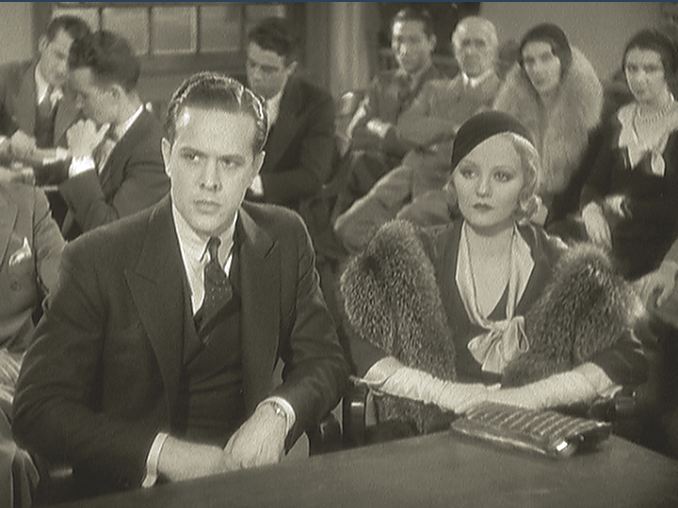
I haven't watched many of Tallulah Bankhead's films, and never really thought of her as a pre-code glamour gal, but after viewing The Cheat I see her in a very different light.  The is the third time the story was filmed, after the 1915 and 1923 versions.  This version was directed by George Abbott and stars Tallulah Bankhead, Irving Pichel, and Harvey Stephens.  When Elsa Carlyle (Bankhead) foolishly gambles away $10,000 on a hunch she uses a charity's money to replace her losses.   Her husband Jeffrey (Stephens) is constantly scolding her because of her extravagant spending, so when he refuses to invest in a supposed "sure thing" tip on the stock market Elsa takes cash from their safe at home and invests the money herself.  The "sure thing" turns out to be a flop, so now she is in deep trouble.

Elsa reluctantly accepts an expensive oriental gown from art collector Hardy Livingstone (Pichel), and figures that he'll only want one thing in return for the gift but tries to act naive.  When she loses her investment money and is embarrassed to tell her husband, she has no choice but to try to get the money from Livingstone because she knows he would do anything to have her.  He offers to replace the cash if she "would only be a little nicer" to him. 

When her husband secures a deal at work, he tells her that they're rich and offers to payoff her debts.  Elsa now thinks her troubles are over but they are really only beginning.  When the time comes to pay off the slime-ball, money won't satisfy him.  As a sort of fetish, Livingstone has small dolls made up to resemble his female conquests, as sort of trophies, and he won't be satisfied until he adds Elsa to his collection.

When he reveals his intentions to her she resists, they scuffle, a shot rings out, and the swine hits the ground (sorry I got a little carried away).  A brief courtroom drama ensues and results in a riot.  And that's about as close as I'll get to revealing the ending. 

Director George Abbott directed three other films in 1931, Secrets of a Secretary with Claudette Colbert, Stolen Heaven with Nancy Carroll, and My Sin with Bankhead and Fredric March.  Pichel starred as Fagin in the 1933 film version of Oliver Twist and appeared in many other films.  He also directed many films including The Most Dangerous Game (1932) and the science fiction classic Destination Moon (1950). 

Pichel does a nice job in the film.  Stephens is rock solid as the loving husband.  Bankhead is cute, but I can think of a few other pre-code cuties that I also enjoy watching.  Of course the the film has references to drug use, sex, infidelity, etc.  Everyone knows that in these pre-code films morals and political correctness go right out the window, so I'll refrain from giving my usual  "view in the context ..." speech.

With a running time of about 68 minutes it goes by pretty quickly, and a good thing too because I don't think I could have taken much more of that scumbag casanova.

Overall a pretty good film with a nice twist at the end.  So if you have an hour or so to kill, check it out ...  I think you'll enjoy it ...

Sunday, November 6, 2011

The General (1926)

This film is a masterpiece, and one of the best and funniest films I have ever seen.  The General was directed by Buster Keaton and Clyde Bruckman, and stars Buster Keaton, Marion Mack, Joe Keaton (Buster's dad), Glen Cavender, and Jim Farley. From making the viewer empathize with the characters, to the thrilling chase scenes, to the some of the funniest moments ever filmed The General has everything.  Every stunt Keaton performs is better than the one before it, and his fascination with trains is evident and the focal point of the entire feature.  I think the attention to detail as well as the chemistry between the main characters is what makes the film so great.

The story begins at the start of the Civil War.  Johnnie Gray (Keaton) tries to enlist as a soldier in the Confederate army.  He gets turned down but not because the army doesn't want him, but because they think he'll be more valuable to them in his current job as an engineer.  Of course they don't explain this to Johnnie so he, and everyone else including his girl, think he didn't join because he was unfit or that he was a coward.

When Johnnie's train is stolen by Union spies the fun begins as he tries to track down his missing locomotive, and his beloved Annabelle (Mack) who was kidnapped while she just happened to be on the train at the time it was taken.  From this point on the film becomes a showcase for Keaton's many talents whether they are his directorial skills, physical stunts, or his slapstick gags and routines.

Marion Mack is adorable, I would love to have her for a sweetheart, and I think she plays the role of the dizzy girlfriend really well.  I personally think she steals some of Buster's thunder in some of the scenes she shares with him.  One great scene has Johnnie Gray and Annabelle being chased by the Union army. While Johnnie has his hands full trying to stay ahead of the enemy, Annabelle picks up a broom and decides to tidy up the engine a bit.  Keaton's reaction is priceless. 

The stunts are unbelievable.  I imagine the film must have been fairly costly to make due to the lavish scenery, props, and cinematography.

The score by composer Robert Israel does just what it should, it enhances every single scene. Overall, what an incredible film.  I actually ended up watching this a few times over the past couple of days, and to be honest with you, I would have no problem sitting through it again. For anyone who isn't familiar with Keaton's work this is a great film to start out with.  And for Keaton fans, just sit down and enjoy the magic one more time ...