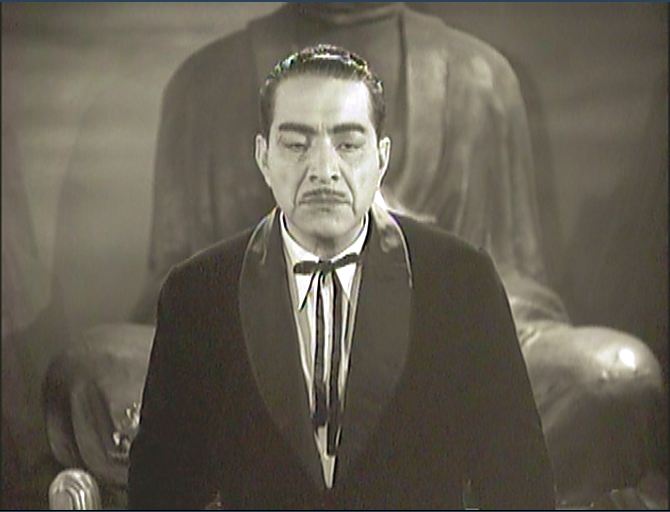
The Phantom Creeps was produced by Universal Pictures and directed by Ford Beebe and Saul A. Goodkind. Commonwealth Pictures was a motion picture company that dealt with the redistributing and reissuing of films and shorts but played no part in actually producing the serial. The screen play was written by George Plympton who also wrote screenplays for some other favorites of mine such as The Green Hornet (1940), Flash Gordon Conquers the Universe (1940), Holt of the Secret Service (1941), Superman (1948), Batman and Robin (1949) and many, many others. The serial stars Bela Lugosi as Dr. Zorka/Dr. Zane, Robert Kent as Capt. Bob West, Dorothy Arnold as reporter Jean Drew, and Edward Van Sloan (sans German accent) as Jarvis the spy chief.
Dr. Zorka is an inventor, but not your average inventor. He invents things like an "invisibility belt" that can render the wearer invisible to the human eye. He's the creator of one of the most evil looking, remote control robots that I've ever seen. And, he's invented some little metal disks that attract exploding mechanical spiders which cause anyone in their vicinity to fall into a state of suspended animation. Of course all these items use the power harnessed from a piece of meteorite that Zorka had previously recovered.
For some reason (potentially lots of money) Zorka doesn't want to share these discoveries with the U.S. Government, so his ex-partner Dr. Mallory (Edwin Stanley) and Zorka's wife (Dora Clement) call the military intelligence officers themselves. After the doctor sabotages the government plane with his exploding spiders, not realizing his wife was also on board, the plane crashes and his wife is killed. Zorka goes mad and vows revenge on everyone and becomes intent on ruling the world. After faking his own death in an automobile accident, and with the help of his inept assistant Monk (Jack C. Smith) who whines about getting caught and sent back to prison in practically every chapter, Zorka uses his "invisibility belt", becoming "The Phantom", to move around unnoticed and prevent the Feds from gaining access to his devices. And, at the same time he tries to stay one step ahead of a gang of international spies, who lead by Jarvis (Van Sloane), are trying to steal his secrets and the meteorite fragment from which he extracts the element that powers all his inventions.
So what we end up with is Zorka trying to track down the "mystery box" containing his stolen meteorite which changes hands so many times, I forget who ends up with it. Monk gets shot by the Feds and the spies so many times throughout the serial I lost count. And of course you have Bela Lugosi putting one hundred percent effort into yet another role that he could have just slugged through half-heartedly. But that's not the way he works. As a matter of fact he looked like he was really enjoying this role. You'll do a little moaning and groaning, and maybe roll your eyes a few times. There are a few over-exaggerated gestures and over the top moments, but they just add a little fun to the overall viewing experience. Dorothy Arnold is cute as the news reporter trying to get a scoop, but she's no Lois Lane.
There's lots of stock footage of building fires and explosions. In one scene a train gets derailed and wrecked and I'm pretty sure it's the same scene that's in Sherlock Holmes and the Voice of Terror (1942). And I think I caught a glimpse of a very young Lee J. Cobb as a demolition crew foreman in one of the last chapters (maybe someone can verify that for me). The serial's chock full of fist fights, car chases and crashes, the giant robot dispensing a few beatings (at one point the military gets involved), and impossible escapes from certain death scenarios. At one point there's a plane crash and one of the G-men just carries someone out of the wreckage, dusts himself off, and goes about his business. Like I said, it's a little rough in some spots but gets better towards the end so try to stick with it.
When Zorka really goes over the edge and starts bombing just about everything he sees, laughing hysterically, you see Lugosi at his best.
You never know what you'll learn watching some of these classics. For instance, I never knew that Dr. Zorka was responsible for the Hindenburg disaster!! Serials are so educational and informative.
Overall it's a fun serial to watch, and Lugosi fans will certainly appreciate his work. I know I did ...
This spot is going to be about all the films I own and love to watch. If you're interested in classic films, serials, and shorts from silents up through the 40s and 50s, and classic TV, keep visiting and posting your comments. I might also be writing about some newer releases now and then, like remakes, but the focus will be on the classics.
Tuesday, September 27, 2011
Monday, September 19, 2011
The Most Dangerous Game (1932)
I know, I know... Some of you folks are saying The Most Dangerous Game is a really good film. And I totally agree . Let me just say I'm not a big fan of the colorization process or the attempt to colorize classic films and shorts. I've always lived by the adage "If it ain't broke, don't fix it", especially when it comes to the classics. That's where the guilt comes in ... Watching The Most Dangerous Game colorized.
The problem is that the color really isn't that good, although some scenes are better than others. It seems as though the color becomes more of an issue, understandably, when there's more movement and action on screen. The edges of the moving objects seem to blur and blend with other surrounding objects and colors in the scene, which results in a very fuzzy image. But. a few of the scenes do look pretty good in color and those kind of help get you through the film.
Based on the 1924 short story of the same name written by Richard Connell, The Most Dangerous Game is a great adventure/drama/horror film. It was the first screen adaptation of the short story, although there were other variations of the story produced afterwards, even being spoofed in a Gilligan's Island episode "The Hunter" with Rory Calhoun guest starring as the title character who hunts Gilligan. There are a lot of big names associated with this film. It was released by RKO, produced by Merian C. Cooper and David O. Selznick, directed by Irving Pichel and Robert Schoedsack, and it boasts a pretty good lineup of stars including Fay Wray, Joel McCrea, Robert Armstrong, Noble Johnson, and Leslie Banks. The musical score by Max Steiner is incredible with, according to IMDB.com, an uncredited Wally Westmore doing a great job as always with the makeup. There's also an uncredited appearance by Larry "Buster" Crabbe as a sailor who falls into the water when the ship explodes, don't blink or you'll miss him!
A yacht carrying a group of men returning from a hunting trip are shipwrecked after hitting a reef in shark infested waters off the coast of a remote island. A sole survivor Bob Rainsford (McCrea), manages to swim to the island's shore. While searching the island he discovers an old secluded fortress inhabited by an eccentric Russian, Count Zaroff (Banks), and his Cossack servants. Speaking to his host Rainsford finds that there are other survivors, brother and sister Martin and Eve Trowbridge (Armstrong and Wray), from a previous shipwreck already staying as guests of the Count. After dinner the other guests explain to the newly arrived Rainsford that they are stranded on the island "temporarily" while the Count's launch is being repaired.
While entertaining his guests the Count recognizes Rainsford as a famous hunter and author, and Zaroff explains how he is a hunter himself, and how he received the scar on his forehead as a result of an attack by a Cape Buffalo in Africa. Zaroff also explains how he was becoming bored with hunting, and after trying different weapons, found that what he needed was to find "a new animal" to hunt. Pulling Rainsford aside Eve expresses her concern about their safety and being held prisoner. She explains how sailors who were shipwrecked with them had each disappeared after the count had showed them his "trophy room".
After the Count sends Eve and Rainsford off to retire for the evening, and quite obviously annoyed by Martin's excessive drinking, Zaroff offers to show Martin his trophy room. Later in the evening, Eve goes to Rainsford's room to ask him for help when she becomes concerned about her brother being missing, and that he was last seen with their host earlier. They come to the conclusion that the most obvious place to begin looking is in the trophy room. While investigating the secret room they discover the gruesome secret to Zaroff's "most dangerous game". When Zaroff returns unexpectedly with his servants carrying a covered body on a stretcher. he finds the two hiding and has Eve taken away to her room (at this point Wray cuts loose with some of her signature screaming) and has Rainsford shackled to the wall.
The Count admits to Rainsford that he had shifted the marker buoys in the channel off the coast in order to sink passing ships and divert survivors to his island. Zaroff, actually trying to reason with Rainsford, tries to talk him into joining him on the hunt. When Rainsford balks at the idea he soon realizes that he is to be the Count's next victim. After escaping from her room Eve finds Zaroff and Rainsford outside the fortress as the Count explains the rules of "the game" and releases the pair into the wild. If Rainsford, taking Eve with him, can survive and elude Zaroff until sunrise he wins the girl and their freedom.
So the hunter becomes the hunted and the stage is set for the deadly game of cat and mouse through the island jungle. The mad Count exchanges his Tartar war bow for a rifle, and then finally releases his hunting dogs on the pair as he chases them through the jungle and swamp, and the pair struggle to stay ahead of him as sunrise slowly approaches.
Armstrong plays his part well but does become more annoying than comical after a while. McCrea is good through most of the film. And Fay Wray, pretty in pink, does a nice job considering her part was created for the film and doesn't exist in the short story. But Banks steals the show playing the part of Zaroff to the hilt as the character seems to drift back and forth over the fine line between sanity and insanity, spending more time in the latter than the former, and rubbing his scarred forehead evoking the demented hunter from within.
Steiner's score drives the chase through the jungle as there is less dialogue during the chase in the second half of the film. Special effects master Ray Harryhausen has explained how important music is to "enhance the visual image" of a film and it definitely works extremely well here. Steiner also composed the music for King Kong (1933) and She (1935), two more great Merian C. Cooper productions.
The film was fairly inexpensive to make, costing only about $200,000, so The Most Dangerous Game was more profitable for RKO than the more expensive production of King Kong was. You'll notice some other similarities between The Most Dangerous Game and King Kong other than the cast. Much of The Most Dangerous Game was shot during the filming of King Kong, so many of the jungle sets were shared by the two films.
So even though I think the original black and white version of the film is better, my guilty pleasure is watching the colorized version of The Most Dangerous Game ... every now and then ...
The problem is that the color really isn't that good, although some scenes are better than others. It seems as though the color becomes more of an issue, understandably, when there's more movement and action on screen. The edges of the moving objects seem to blur and blend with other surrounding objects and colors in the scene, which results in a very fuzzy image. But. a few of the scenes do look pretty good in color and those kind of help get you through the film.
Based on the 1924 short story of the same name written by Richard Connell, The Most Dangerous Game is a great adventure/drama/horror film. It was the first screen adaptation of the short story, although there were other variations of the story produced afterwards, even being spoofed in a Gilligan's Island episode "The Hunter" with Rory Calhoun guest starring as the title character who hunts Gilligan. There are a lot of big names associated with this film. It was released by RKO, produced by Merian C. Cooper and David O. Selznick, directed by Irving Pichel and Robert Schoedsack, and it boasts a pretty good lineup of stars including Fay Wray, Joel McCrea, Robert Armstrong, Noble Johnson, and Leslie Banks. The musical score by Max Steiner is incredible with, according to IMDB.com, an uncredited Wally Westmore doing a great job as always with the makeup. There's also an uncredited appearance by Larry "Buster" Crabbe as a sailor who falls into the water when the ship explodes, don't blink or you'll miss him!
A yacht carrying a group of men returning from a hunting trip are shipwrecked after hitting a reef in shark infested waters off the coast of a remote island. A sole survivor Bob Rainsford (McCrea), manages to swim to the island's shore. While searching the island he discovers an old secluded fortress inhabited by an eccentric Russian, Count Zaroff (Banks), and his Cossack servants. Speaking to his host Rainsford finds that there are other survivors, brother and sister Martin and Eve Trowbridge (Armstrong and Wray), from a previous shipwreck already staying as guests of the Count. After dinner the other guests explain to the newly arrived Rainsford that they are stranded on the island "temporarily" while the Count's launch is being repaired.
While entertaining his guests the Count recognizes Rainsford as a famous hunter and author, and Zaroff explains how he is a hunter himself, and how he received the scar on his forehead as a result of an attack by a Cape Buffalo in Africa. Zaroff also explains how he was becoming bored with hunting, and after trying different weapons, found that what he needed was to find "a new animal" to hunt. Pulling Rainsford aside Eve expresses her concern about their safety and being held prisoner. She explains how sailors who were shipwrecked with them had each disappeared after the count had showed them his "trophy room".
After the Count sends Eve and Rainsford off to retire for the evening, and quite obviously annoyed by Martin's excessive drinking, Zaroff offers to show Martin his trophy room. Later in the evening, Eve goes to Rainsford's room to ask him for help when she becomes concerned about her brother being missing, and that he was last seen with their host earlier. They come to the conclusion that the most obvious place to begin looking is in the trophy room. While investigating the secret room they discover the gruesome secret to Zaroff's "most dangerous game". When Zaroff returns unexpectedly with his servants carrying a covered body on a stretcher. he finds the two hiding and has Eve taken away to her room (at this point Wray cuts loose with some of her signature screaming) and has Rainsford shackled to the wall.
The Count admits to Rainsford that he had shifted the marker buoys in the channel off the coast in order to sink passing ships and divert survivors to his island. Zaroff, actually trying to reason with Rainsford, tries to talk him into joining him on the hunt. When Rainsford balks at the idea he soon realizes that he is to be the Count's next victim. After escaping from her room Eve finds Zaroff and Rainsford outside the fortress as the Count explains the rules of "the game" and releases the pair into the wild. If Rainsford, taking Eve with him, can survive and elude Zaroff until sunrise he wins the girl and their freedom.
So the hunter becomes the hunted and the stage is set for the deadly game of cat and mouse through the island jungle. The mad Count exchanges his Tartar war bow for a rifle, and then finally releases his hunting dogs on the pair as he chases them through the jungle and swamp, and the pair struggle to stay ahead of him as sunrise slowly approaches.
Armstrong plays his part well but does become more annoying than comical after a while. McCrea is good through most of the film. And Fay Wray, pretty in pink, does a nice job considering her part was created for the film and doesn't exist in the short story. But Banks steals the show playing the part of Zaroff to the hilt as the character seems to drift back and forth over the fine line between sanity and insanity, spending more time in the latter than the former, and rubbing his scarred forehead evoking the demented hunter from within.
Steiner's score drives the chase through the jungle as there is less dialogue during the chase in the second half of the film. Special effects master Ray Harryhausen has explained how important music is to "enhance the visual image" of a film and it definitely works extremely well here. Steiner also composed the music for King Kong (1933) and She (1935), two more great Merian C. Cooper productions.
The film was fairly inexpensive to make, costing only about $200,000, so The Most Dangerous Game was more profitable for RKO than the more expensive production of King Kong was. You'll notice some other similarities between The Most Dangerous Game and King Kong other than the cast. Much of The Most Dangerous Game was shot during the filming of King Kong, so many of the jungle sets were shared by the two films.
So even though I think the original black and white version of the film is better, my guilty pleasure is watching the colorized version of The Most Dangerous Game ... every now and then ...
Friday, September 9, 2011
Twilight Zone - Episode 142 - An Occurrence at Owl Creek Bridge -- Original Air Date - February 28,1964
Winner of the Cannes Film Festival 1962, and winner of many other international awards, An Occurrence at Owl Creek Bridge opens with a special introduction by Rod Serling. According to Mr. Serling's intro the film was shot in France by "others", and is a "haunting study of the incredible".
The "others" that Mr. Serling was referring to were Ambrose Bierce, whose short story the episode is based on, producers Marcel Ichac and Paul de Roubaix, and director Robert Enrico.
First off the cinematography is incredible. The camera sweeps across a forest of barren trees to a small railroad bridge that crosses a creek. A squad of union soldiers march a prisoner (Roger Jacquet) across the span and prepare to hang the confederate collaborator.
The entire episode has a nightmarish quality to it, especially when the camera switches to the prisoner's point of view showing him looking from one end of the bridge to the other, only to see soldiers standing guard at any possible route of escape. The camera pans down to show him standing on a plank, with a soldier standing opposite him holding down the other end of the plank preventing him from falling, suspended above the water below and the noose carefully being placed around his neck. The suspense builds to an almost intolerable level as the soldiers bind the prisoner's legs and feet, his hands already bound behind his back, and the sun rises and day breaks slowly over the hillside. The condemned man closes his eyes and with a tear running down his cheek sees visions of his wife and children.
At this point I was about to reach for my anxiety medication when the Union officer gave the command, the soldier stepped off his end of the plank, and the prisoner plummeted down into the river below trailing the broken rope behind him as he sank deep into the water. Struggling below the water's surface, he manages to untie himself and make his escape down river evading the enemy gunfire, caught in swirling river waters, and swept downstream. The man pulls himself up on to the riverbank delirious that he is alive and has avoided being captured. But the feeling is short lived as he realizes the soldiers are in pursuit.
Of course we're talking about the Twilight Zone here, a world of imagination and fantasy where nothing is as it seems. The story was purchased for $25,000 by producer William Froug, but the purchase allowed the film to be aired only twice. According to Marc Scott Zicree's The Twilight Zone Companion "An Occurrence at Owl Creek Bridge was the last episode of the classic Twilight Zone series to be "produced" (presumably referencing the reediting and the addition of footage of Rod Serling, as production of the series was cancelled afterwards.) It was not, however, the last episode of the series to be broadcast".
This is one of my favorite episodes and classic Twilight Zone from start to finish.
The "others" that Mr. Serling was referring to were Ambrose Bierce, whose short story the episode is based on, producers Marcel Ichac and Paul de Roubaix, and director Robert Enrico.
First off the cinematography is incredible. The camera sweeps across a forest of barren trees to a small railroad bridge that crosses a creek. A squad of union soldiers march a prisoner (Roger Jacquet) across the span and prepare to hang the confederate collaborator.
The entire episode has a nightmarish quality to it, especially when the camera switches to the prisoner's point of view showing him looking from one end of the bridge to the other, only to see soldiers standing guard at any possible route of escape. The camera pans down to show him standing on a plank, with a soldier standing opposite him holding down the other end of the plank preventing him from falling, suspended above the water below and the noose carefully being placed around his neck. The suspense builds to an almost intolerable level as the soldiers bind the prisoner's legs and feet, his hands already bound behind his back, and the sun rises and day breaks slowly over the hillside. The condemned man closes his eyes and with a tear running down his cheek sees visions of his wife and children.
At this point I was about to reach for my anxiety medication when the Union officer gave the command, the soldier stepped off his end of the plank, and the prisoner plummeted down into the river below trailing the broken rope behind him as he sank deep into the water. Struggling below the water's surface, he manages to untie himself and make his escape down river evading the enemy gunfire, caught in swirling river waters, and swept downstream. The man pulls himself up on to the riverbank delirious that he is alive and has avoided being captured. But the feeling is short lived as he realizes the soldiers are in pursuit.
Of course we're talking about the Twilight Zone here, a world of imagination and fantasy where nothing is as it seems. The story was purchased for $25,000 by producer William Froug, but the purchase allowed the film to be aired only twice. According to Marc Scott Zicree's The Twilight Zone Companion "An Occurrence at Owl Creek Bridge was the last episode of the classic Twilight Zone series to be "produced" (presumably referencing the reediting and the addition of footage of Rod Serling, as production of the series was cancelled afterwards.) It was not, however, the last episode of the series to be broadcast".
This is one of my favorite episodes and classic Twilight Zone from start to finish.
Tuesday, August 30, 2011
Blondie! (1938)
You know, it's always nice to watch a film that you haven't seen in years. Blondie! is definitely one of those films. I had forgotten how great the cast was and how well they worked together. Released by Columbia Pictures and directed by Frank R. Strayer, Blondie! is the first of almost thirty "episodes" in the comedy series and it is hilarious from start to finish.
Dagwood (Arthur Lake) has cosigned a note for one of his coworkers named Elsie and now owes the loan company a grand total of $563.80. What makes matters worse is that his fifth wedding anniversary is rapidly approaching and Blondie (Penny Singleton) has bought new furniture that he hasn't found out about yet. The only way out of this jam is for Dagwood to get land developer C.P. Hazlip (Gene Lockhart) to sign a contract with his employer Mr. Dithers (Jonathan Hale), who in turn promises Dagwood a raise and a bonus that would cover what Dagwood owes. Not as easy as it sounds because Hazlip is known for avoiding salesman and just not being an easy person to see in general.
In one of the funniest scenes in the film Dagwood sits next to a stranger in the hotel lobby waiting for Hazlip to show up, unknown to Dagwood that the stranger is Hazlip, the two observe a hotel porter (Willie Best) tinkering with a vacuum cleaner. The two men sneak the vacuum cleaner up to Hazlip's room to try to fix it when Hazlip's daughter Elsie (Ann Doran) shows up and Dagwood finds out who his new friend really is. Blondie finds out that Dagwood is at the hotel and mistakes Elsie Hazlip for the Elsie that Dagwood cosigned the note for and thinks that he's having an affair. All this is complicated even further by the arrival of one of Blondie's old flames (Gordon Oliver), her mother (Gene's wife Kathleen Lockhart), and her sister Dot (Dorothy Moore). The film gets more chaotic and more entertaining as things progress.
Baby Dumpling (Larry Simms) is great in every scene he's in, whether it's delivering his little one line zingers or his antics with his neighbor Alvin (Danny Mummert). Gene Lockhart is one of those actors that's great in every part he plays and seems to do it without effort. Penny Singleton is uber perky and perfectly cast as Blondie, and Arthur Lake is the quintessential Dagwood. Oh, I almost forgot, Daisy is just adorable.
Bottom line, this is a really funny film and no matter what age group you fall into you'll enjoy some very entertaining moments and maybe it'll bring back some fond memories. And at about 70 minutes the laughs come at you pretty quick. So if no one minds, I think I'll go watch another one.
Dagwood (Arthur Lake) has cosigned a note for one of his coworkers named Elsie and now owes the loan company a grand total of $563.80. What makes matters worse is that his fifth wedding anniversary is rapidly approaching and Blondie (Penny Singleton) has bought new furniture that he hasn't found out about yet. The only way out of this jam is for Dagwood to get land developer C.P. Hazlip (Gene Lockhart) to sign a contract with his employer Mr. Dithers (Jonathan Hale), who in turn promises Dagwood a raise and a bonus that would cover what Dagwood owes. Not as easy as it sounds because Hazlip is known for avoiding salesman and just not being an easy person to see in general.
In one of the funniest scenes in the film Dagwood sits next to a stranger in the hotel lobby waiting for Hazlip to show up, unknown to Dagwood that the stranger is Hazlip, the two observe a hotel porter (Willie Best) tinkering with a vacuum cleaner. The two men sneak the vacuum cleaner up to Hazlip's room to try to fix it when Hazlip's daughter Elsie (Ann Doran) shows up and Dagwood finds out who his new friend really is. Blondie finds out that Dagwood is at the hotel and mistakes Elsie Hazlip for the Elsie that Dagwood cosigned the note for and thinks that he's having an affair. All this is complicated even further by the arrival of one of Blondie's old flames (Gordon Oliver), her mother (Gene's wife Kathleen Lockhart), and her sister Dot (Dorothy Moore). The film gets more chaotic and more entertaining as things progress.
Baby Dumpling (Larry Simms) is great in every scene he's in, whether it's delivering his little one line zingers or his antics with his neighbor Alvin (Danny Mummert). Gene Lockhart is one of those actors that's great in every part he plays and seems to do it without effort. Penny Singleton is uber perky and perfectly cast as Blondie, and Arthur Lake is the quintessential Dagwood. Oh, I almost forgot, Daisy is just adorable.
Bottom line, this is a really funny film and no matter what age group you fall into you'll enjoy some very entertaining moments and maybe it'll bring back some fond memories. And at about 70 minutes the laughs come at you pretty quick. So if no one minds, I think I'll go watch another one.
Tuesday, August 23, 2011
Sherlock Holmes in "Pearl of Death" (1944)
I have to say this is one of my favorite films of the series and is based on the Sir Arthur Conan Doyle story "The Adventure of the Six Napoleons". Pearl of Death begins on board a ship with the theft of an expensive jewel, the Borgia Pearl. The pearl is stolen by a member of a gang of international jewel thieves, Naomi Drake (Evelyn Ankers). Sherlock Holmes (Basil Rathbone) then cleverly acquires possession of the pearl from the thief only to have it stolen again, due to Holmes's carelessness, by another member of the gang Giles Conover (Miles Mander) as it is being displayed at the Royal Regent Museum.
As Holmes begins to collect evidence and clues as to the whereabouts of the criminals he also connects a string of murders, with smashed china and bric-a-brac at the scenes, to the disappearance of the jewel getting Holmes, Watson (Nigel Bruce), and Inspector Lestrade (Dennis Hoey) closer to solving the mystery.
As the investigation progresses Holmes finds that he is also up against another Scotland Yard foe the Hoxton Creeper (Rondo Hatton), whose signature method of killing is breaking people's backs. According to MPI's promotional info, Hatton didn't have to spend much time in Universal makeup master Jack Pierce's chair for this film. That time was reserved for Rathbone who uses two disguises, Mander who also dons two different disguises, and Ankers who sports three different disguises throughout the film, making her a bit more deceptive than our beloved Holmes.
This was the seventh Sherlock Holmes film released by Universal, but the ninth film in the series, the first two The Hound of the Baskervilles (1939) and The Adventures of Sherlock Holmes (1939) being released by Twentieth Century Fox. Nigel Bruce is at his grumbling best as Dr John Watson and cleverly, but respectfully, exchanges barbs and wisecracks with Holmes and Lestrade throughout the film to lighten the mood a bit. In one scene he tests his powers of deduction when he tries to locate a newspaper clipping that mysteriously disappears. Hatton is as creepy as ever as the Creeper, or as Lestrade calls him "the 'Oxton 'Orror". Miles Mander appeared in another Holmes film, The Scarlet Claw (1944) as one of the victims "Judge Brisson", as well as other films including Wuthering Heights (1939), Phantom of the Opera (1943), and Murder, My Sweet (1944).
This film was a bit of a change for Ankers who usually played the victim rather than the villain. Earlier in 1944 Ankers appeared in one of Universal's Inner Sanctum Thrillers, The Weird Woman, as well as in The Invisible Man's Revenge, and of course The Wolfman in (1941). She also appeared as Kitty in Sherlock Holmes and the Voice of Terror (1942). Roy William Neill directed The Pearl of Death along with several other films in the series including Sherlock Holmes and the House of Fear (1945), Sherlock Holmes in Terror by Night (1946), and Sherlock Holmes in Dressed to Kill (1946).
Great film, one of the best of the series. A must see for any Sherlock Holmes fan.
As Holmes begins to collect evidence and clues as to the whereabouts of the criminals he also connects a string of murders, with smashed china and bric-a-brac at the scenes, to the disappearance of the jewel getting Holmes, Watson (Nigel Bruce), and Inspector Lestrade (Dennis Hoey) closer to solving the mystery.
As the investigation progresses Holmes finds that he is also up against another Scotland Yard foe the Hoxton Creeper (Rondo Hatton), whose signature method of killing is breaking people's backs. According to MPI's promotional info, Hatton didn't have to spend much time in Universal makeup master Jack Pierce's chair for this film. That time was reserved for Rathbone who uses two disguises, Mander who also dons two different disguises, and Ankers who sports three different disguises throughout the film, making her a bit more deceptive than our beloved Holmes.
This was the seventh Sherlock Holmes film released by Universal, but the ninth film in the series, the first two The Hound of the Baskervilles (1939) and The Adventures of Sherlock Holmes (1939) being released by Twentieth Century Fox. Nigel Bruce is at his grumbling best as Dr John Watson and cleverly, but respectfully, exchanges barbs and wisecracks with Holmes and Lestrade throughout the film to lighten the mood a bit. In one scene he tests his powers of deduction when he tries to locate a newspaper clipping that mysteriously disappears. Hatton is as creepy as ever as the Creeper, or as Lestrade calls him "the 'Oxton 'Orror". Miles Mander appeared in another Holmes film, The Scarlet Claw (1944) as one of the victims "Judge Brisson", as well as other films including Wuthering Heights (1939), Phantom of the Opera (1943), and Murder, My Sweet (1944).
This film was a bit of a change for Ankers who usually played the victim rather than the villain. Earlier in 1944 Ankers appeared in one of Universal's Inner Sanctum Thrillers, The Weird Woman, as well as in The Invisible Man's Revenge, and of course The Wolfman in (1941). She also appeared as Kitty in Sherlock Holmes and the Voice of Terror (1942). Roy William Neill directed The Pearl of Death along with several other films in the series including Sherlock Holmes and the House of Fear (1945), Sherlock Holmes in Terror by Night (1946), and Sherlock Holmes in Dressed to Kill (1946).
Great film, one of the best of the series. A must see for any Sherlock Holmes fan.
Monday, August 8, 2011
Batman (1943)
Lewis Wilson stars as Batman in the caped crusader's first big screen appearance. Along with his trusted sidekick, "Robin the Boy Wonder" (Douglas Croft), they fight to protect Gotham City, and the world, from the clutches of the evil Dr. Tito Daka (J. Carrol Naish), his "Radium Powered Ray Gun" and his "Zombie Machine". The 15 episode serial was released by Columbia Pictures and I have to admit it sounds promising, but doesn't deliver. The serial plays up Batman's alter ego "Bruce Wayne" as extremely lazy and untrustworthy, rather than suave and sophisticated, as he keeps his girlfriend "Linda Page" (Shirley Patterson) in the dark about his identity. I can see where he would want to hide his Batman identity but I think they go a little overboard.
The Dynamic Duo work as government agents attempting to uncover Axis plots instead of acting as vigilantes which is truer to the comic origin. The air is thick with anti-Japanese slurs, especially with the serial being released after the bombing of Pearl Harbor and the U.S. entry into World War II. Anyone easily offended might take exception to some of the dialogue. But, like other films and serials from that era, they have to be viewed in the context of the times.
The chemistry just doesn't seem to click between the main characters causing the serial to fall a little flat. Most of the bad guys I recognized as some of the Columbia contracted "mugs and thugs" that appear in other Columbia shorts and serials. Naish does a good job as usual, and Charles Middleton appears in a few episodes as a prospector with a Radium mine, and the bad guys are after him for a change, he usually plays the villain.
There are a few good stunts, mostly car crashes etc., but a lot of the action that goes on might cause the viewer to just shake their head and chuckle. In one scene Batman gets thrown down an elevator shaft and hits the bottom in a puff of dust like "Wile E. Coyote" in a "Road Runner" cartoon, only to get up in the next scene saying "that was a close one ". In another scene Batman and Robin try to gain access to one of the crook's hideouts when Batman remarks about how "well guarded the place is", then they simply just climb over the high iron fence and onto the property without being noticed.
The punches fly like a windmill in a hurricane, but everyone just keeps getting right up for more punishment. The character "Alfred" (William Austin) is too bumbling, unlike the aristocratic and polished character played by Alan Napier in the Batman film and television series of the 60's.
The "Bat's Cave" is a cave with a desk, a telephone, and a couple of chairs in it. There's no "Batmobile", just a Cadillac convertible with a large backseat where most of the Bruce Wayne to Batman / Dick Grayson to Robin and vice versa transformations take place. Columbia was obviously on a limited budget judging by the repeated use of sets and locations used for filming. And the "bat ears" on Batman's cowl look more like devil horns.
I hope I don't sound like I'm totally trashing the serial, it has it's moments, but I think only true Batman and serial fans will really appreciate it.
Sunday, July 31, 2011
The Monolith Monsters (1957)
"From time immemorial the earth has been bombarded by objects from outer space, bits and pieces of the universe piercing our atmosphere in an invasion that never ends". With these words begins the classic 50s sci fi monster film The Monolith Monsters. Released by Universal-International films and with the introduction narrated by Paul Frees, the master narrator of countless science fiction films, you already know that you're in for a great time.
The story begins as a meteorite from the depths of space hits the earth creating a massive crater and scattering pieces of it about the landscape of the desert. "Ben" (Phil Harvey) a geologist from the Department of the Interior picks up a sample of a strange rock and returns it to his lab. He analyzes the rock but doesn't recognize any of the components. During the night an accident in the lab causes water to be spilled on the sample which causes the rock to grow out of control. "Dave Miller" (Grant Williams) arrives at the lab the next morning and finds everything in a shambles and then also discovers Ben's body which seems to have been petrified, turned to solid stone. Ben is the first to fall victim to the Monolith Monsters.
Meanwhile school teacher "Cathy Barrett" (Lola Albright) takes some of her students on a field trip to the desert where one of the children unknowingly picks up one of the pieces of meteorite and brings it home totally oblivious of the danger.
As Dave and the authorities begin an investigation they soon discover more destruction. Homes, farms, people, all crushed under tons of the alien rock, and then they find many more pieces of it scattered about the area as well as finding people who are still alive, but are beginning to turn to stone. Newspaper reporter "Martin Cochrane" (Les Tremayne) also aids the authorities with the investigation. Recruiting Professor "Arthur Flanders" (Trevor Bardette) a geologist from the local college, the group soon finds that not only do they need to find a way to stop the monolith stones from growing and advancing towards the town they must also find a cure for the people who have been infected.
Dave and Prof. Flanders venture out in the pouring rain into the desert and find the crater where the meteorite landed and watch as the stones grow and collapse right before their eyes. They race back to the lab to attempt to solve the mystery. The clock begins to tick as the rainstorm continues and the pieces of meteorite grow and collapse uncontrollably advancing towards and threatening the town and all it's inhabitants. The group notifies the Chief of Police "Dan Corey" (William Flaherty) that the town may need to be evacuated. They explain that the town of San Angelo will be destroyed like "an avalanche sweeps over an anthill" and that "each one that shatters will make a hundred more". They hurry to find a solution knowing that if they don't, the town is doomed.
This is a great story with an excellent musical score. There are some pretty tense moments as the monoliths approach the town and the panic starts. The film also has some really good special effects. and the makeup is done courtesy of Bud Westmore of the Westmore dynasty of makeup artists. I think this is one of the best of the 50's science fiction monster films, because I've actually seen it quite a few times and I'm never disappointed. The film is also unique in that it doesn't involve atomic testing, radiation exposure or giant mutated bugs or animals.
To be honest with you, there's really not a lot of action in the film but it seems to keep the viewer interested and on the edge of their seat. Oh, I almost forgot. Keep an eye out for one of the hardest working people in film and television William Schallert who appears briefly as a meteorologist at the weather bureau. So get the popcorn ready because this film is definitely worth checking out.
The story begins as a meteorite from the depths of space hits the earth creating a massive crater and scattering pieces of it about the landscape of the desert. "Ben" (Phil Harvey) a geologist from the Department of the Interior picks up a sample of a strange rock and returns it to his lab. He analyzes the rock but doesn't recognize any of the components. During the night an accident in the lab causes water to be spilled on the sample which causes the rock to grow out of control. "Dave Miller" (Grant Williams) arrives at the lab the next morning and finds everything in a shambles and then also discovers Ben's body which seems to have been petrified, turned to solid stone. Ben is the first to fall victim to the Monolith Monsters.
Meanwhile school teacher "Cathy Barrett" (Lola Albright) takes some of her students on a field trip to the desert where one of the children unknowingly picks up one of the pieces of meteorite and brings it home totally oblivious of the danger.
As Dave and the authorities begin an investigation they soon discover more destruction. Homes, farms, people, all crushed under tons of the alien rock, and then they find many more pieces of it scattered about the area as well as finding people who are still alive, but are beginning to turn to stone. Newspaper reporter "Martin Cochrane" (Les Tremayne) also aids the authorities with the investigation. Recruiting Professor "Arthur Flanders" (Trevor Bardette) a geologist from the local college, the group soon finds that not only do they need to find a way to stop the monolith stones from growing and advancing towards the town they must also find a cure for the people who have been infected.
Dave and Prof. Flanders venture out in the pouring rain into the desert and find the crater where the meteorite landed and watch as the stones grow and collapse right before their eyes. They race back to the lab to attempt to solve the mystery. The clock begins to tick as the rainstorm continues and the pieces of meteorite grow and collapse uncontrollably advancing towards and threatening the town and all it's inhabitants. The group notifies the Chief of Police "Dan Corey" (William Flaherty) that the town may need to be evacuated. They explain that the town of San Angelo will be destroyed like "an avalanche sweeps over an anthill" and that "each one that shatters will make a hundred more". They hurry to find a solution knowing that if they don't, the town is doomed.
This is a great story with an excellent musical score. There are some pretty tense moments as the monoliths approach the town and the panic starts. The film also has some really good special effects. and the makeup is done courtesy of Bud Westmore of the Westmore dynasty of makeup artists. I think this is one of the best of the 50's science fiction monster films, because I've actually seen it quite a few times and I'm never disappointed. The film is also unique in that it doesn't involve atomic testing, radiation exposure or giant mutated bugs or animals.
To be honest with you, there's really not a lot of action in the film but it seems to keep the viewer interested and on the edge of their seat. Oh, I almost forgot. Keep an eye out for one of the hardest working people in film and television William Schallert who appears briefly as a meteorologist at the weather bureau. So get the popcorn ready because this film is definitely worth checking out.
Tuesday, July 26, 2011
I Love Lucy - Season 3, Episode 28 - Tennessee Ernie Visits -- First aired May 3, 1954
A few of my many favorite I Love Lucy episodes are the ones that include guest star Tennessee Ernie Ford. In this first episode the Ricardo's receive a special delivery letter from Lucy's mother notifying them that they are to play host to Lucy's mother's friend's roommate's cousin's middle boy, Ernie from Bent Fork, Tennessee.
Aside from the usual Lucy (Lucille Ball) and Ricky(Desi Arnaz), and Fred (William Frawley)and Ethel (Vivian Vance) shenanigans the laughs increase exponentially as Ernie tells the Ricardo's the story of his first few hours in New York City. The highlights include Ernie's first subway ride out to, and walk back from Long Island (and he'll "be ding-donged if it ain't"), and his first night sleeping in a rollaway bed ("I don't wanna lay down on anythin' that's gonna be a galavantin' around the room all night").
After reading a letter that Ernie is writing to his mother back home Lucy gets an idea to try to get rid of Ernie, and Ricky's so desperate he goes along with it. Lucy dresses up like a "wicked city woman" to try to scare him but things don't turn out exactly planned.
Lucy is as stunning as ever, and Desi is suave and debonaire. The chemistry between all the players never fails to amaze me. It's no wonder the show has survived all these decades and I'm pretty positive will be around for many more years to come. I wonder in 50 or 60 years what kind of shows people will be watching? Besides I Love Lucy of course ...
Aside from the usual Lucy (Lucille Ball) and Ricky(Desi Arnaz), and Fred (William Frawley)and Ethel (Vivian Vance) shenanigans the laughs increase exponentially as Ernie tells the Ricardo's the story of his first few hours in New York City. The highlights include Ernie's first subway ride out to, and walk back from Long Island (and he'll "be ding-donged if it ain't"), and his first night sleeping in a rollaway bed ("I don't wanna lay down on anythin' that's gonna be a galavantin' around the room all night").
After reading a letter that Ernie is writing to his mother back home Lucy gets an idea to try to get rid of Ernie, and Ricky's so desperate he goes along with it. Lucy dresses up like a "wicked city woman" to try to scare him but things don't turn out exactly planned.
Lucy is as stunning as ever, and Desi is suave and debonaire. The chemistry between all the players never fails to amaze me. It's no wonder the show has survived all these decades and I'm pretty positive will be around for many more years to come. I wonder in 50 or 60 years what kind of shows people will be watching? Besides I Love Lucy of course ...
Tuesday, July 19, 2011
Blackmail (1929)
Blackmail was Alfred Hitchcock's first sound film, released by British International Pictures, and according to promotional material was the "first full length all talkie film made in Great Britain". The first time I saw this film I thought it actually was a silent film but was very surprised when the characters began speaking. The first few minutes are a little misleading because there is only a soundtrack with some special effects sounds. Speaking of soundtrack the music is provided courtesy of the British International Symphony Orchestra.
Classic Hitchcock suspense and style is evident in the opening minutes of the film with the use of extraordinary camera angles and imagery, as a criminal sees the image of the police in the doorway of his apartment reflected off of a candlestick while he nervously contemplates reaching for a pistol. More of the master's style is displayed as he demonstrates the passage of time during a police interrogation not with the spinning hands of a clock as any other director would, but with the accumulation of cigarette butts in an ashtray.
The heart of the story begins as "Alice White" (Anny Ondra) waits at Scotland Yard for her fiancé "Detective Frank Webber" (John Longdon) to finish his shift. She half-heartedly accepts his invitation for a date and suggests they go to a restaurant rather than go to a movie. What Frank didn't know was that Alice secretly wanted to meet someone else at that restaurant at the same time. After a brief argument Frank leaves and stops outside to cool off a bit, but as he's standing there he notices Alice leave with another man, an artist (Cyril Ritchard) who lives near Alice. While walking Alice home the artist lures her up to his apartment and tries to take advantage of her. Alice fights back and while defending herself stabs the artist killing him. She escapes and wanders the streets dazed before she returns home where she lives with her parents (Sara Allgood, Charles Paton).
Frank is assigned to the murder case and it doesn't take him long to determine that the man that was killed is the same man that was with Alice earlier, and that she is involved with the crime. But a local career criminal and hoodlum named "Tracy" (Donald Calthrop) also suspects Alice's involvement and, after seeing her speaking to Frank, decides to blackmail the two of them. Everything goes along smoothly for Tracy until Hitchcock tosses one of his trademark wrenches into the works. Of course everything builds to a fever pitch and ends with a climactic chase through the British Museum
Anny Ondra just seems to glow when she's on screen, she is just beautiful. She was also in Hitchcock's The Manxman (1929). Cyril Ritchard starred as "Captain Hook" opposite Mary Martin's Peter Pan (1960). And Sara Allgood appeared in many films including How Green Was My Valley (1941), The Spiral Staircase (1946), and Cluny Brown (1946).
This is a great film and probably one of my top five Hitchcock films. He had made probably a dozen or so films before Blackmail and we can see that he had already begun his longtime fascination with choosing blondes as leading ladies. Don't forget to watch for his quick cameo appearance a few minutes into the film. If you're not familiar with Hitchcock's early work, this is a perfect film to start out with and get acquainted with the master.
Classic Hitchcock suspense and style is evident in the opening minutes of the film with the use of extraordinary camera angles and imagery, as a criminal sees the image of the police in the doorway of his apartment reflected off of a candlestick while he nervously contemplates reaching for a pistol. More of the master's style is displayed as he demonstrates the passage of time during a police interrogation not with the spinning hands of a clock as any other director would, but with the accumulation of cigarette butts in an ashtray.
The heart of the story begins as "Alice White" (Anny Ondra) waits at Scotland Yard for her fiancé "Detective Frank Webber" (John Longdon) to finish his shift. She half-heartedly accepts his invitation for a date and suggests they go to a restaurant rather than go to a movie. What Frank didn't know was that Alice secretly wanted to meet someone else at that restaurant at the same time. After a brief argument Frank leaves and stops outside to cool off a bit, but as he's standing there he notices Alice leave with another man, an artist (Cyril Ritchard) who lives near Alice. While walking Alice home the artist lures her up to his apartment and tries to take advantage of her. Alice fights back and while defending herself stabs the artist killing him. She escapes and wanders the streets dazed before she returns home where she lives with her parents (Sara Allgood, Charles Paton).
Frank is assigned to the murder case and it doesn't take him long to determine that the man that was killed is the same man that was with Alice earlier, and that she is involved with the crime. But a local career criminal and hoodlum named "Tracy" (Donald Calthrop) also suspects Alice's involvement and, after seeing her speaking to Frank, decides to blackmail the two of them. Everything goes along smoothly for Tracy until Hitchcock tosses one of his trademark wrenches into the works. Of course everything builds to a fever pitch and ends with a climactic chase through the British Museum
Anny Ondra just seems to glow when she's on screen, she is just beautiful. She was also in Hitchcock's The Manxman (1929). Cyril Ritchard starred as "Captain Hook" opposite Mary Martin's Peter Pan (1960). And Sara Allgood appeared in many films including How Green Was My Valley (1941), The Spiral Staircase (1946), and Cluny Brown (1946).
This is a great film and probably one of my top five Hitchcock films. He had made probably a dozen or so films before Blackmail and we can see that he had already begun his longtime fascination with choosing blondes as leading ladies. Don't forget to watch for his quick cameo appearance a few minutes into the film. If you're not familiar with Hitchcock's early work, this is a perfect film to start out with and get acquainted with the master.
Tuesday, July 12, 2011
Superman (1948)
First thing is that I think Kirk Alyn was a great Superman. I found him to be very believable as both Clark Kent and Superman, although I still can't understand how no one can recognize that they are the same person, but that's neither here nor there. As a matter of fact I think everyone, including Noel Neill as "Lois Lane" and Tommy Bond (Butch from the "Our Gang" series) as Jimmy Olsen do a wonderful job. The only issue I have is with Lois's hat, maybe stylish back then, but what the ... !!! Actually all the costumes seem to be very similar from episode to episode, perhaps to keep costs down.
Maybe it's just me, but I love these old serials. I just think that they're a lot of fun to watch, a little dated perhaps, but they're fun. There's lots of excitement and action. Superman captures bank robbers, rescues a woman from a fire, prevents a train derailment and rescues miners trapped in a cave in. And this is just in the first few episodes! I think it's great that most of the time the men are all wearing suits and ties and hats, even the bad guys. I guess we were a very civilized well-dressed society at one time ...
Another great thing is the music. Musical director Mischa Bakaleinikoff is in charge of the music for the serial, and it is incredible. Bakaleinikoff's musical scores can be heard in such films as "Ladies of Leisure" (1930) and "The Vampire Bat" (1933), to "The Big Heat" (1953) and "Earth vs. the Flying Saucers" (1956) and many. many, many more.
In the first 15 chapters Superman battles the "Spider Lady" (Carol Forman), and in the last 15 episodes it's "Atom Man vs. Superman" (1950) with Lyle Talbot as the sinister, evil and plotting "Lex Luthor." I wish I could have been around when these were originally shown on the big screen in theaters, it must have been a great experience.
So grab some popcorn and your favorite drink and prepare to be entertained.
Wednesday, July 6, 2011
Mystery of the Wax Museum (1933)
Mystery of the Wax Museum is a great early horror film. Released in 1933 by Warner Brothers and Vitaphone it demonstrates one of the last commercial uses of the Technicolor two-strip process. The film was actually thought to have been lost until the early 60s.
The story begins in London in 1921. Artist "Ivan Igor" (Lionel Atwill) is part owner of a wax museum. His partner "Joe Worth" (Edwin Maxwell) comes up with the idea of burning down the building in order to collect on the insurance. Igor opposes the plan and when the two men struggle the museum is accidentally set ablaze. Worth escapes the flames but Igor is trapped inside and everything is destroyed. Worth leaves his partner to perish in the flames.
Years later in New York "The London Wax Museum" is planning a grand opening. But as the new museum prepares to open, people begin to disappear. When a young woman is found dead, police arrest her wealthy boyfriend for murder. But when an autopsy is ordered to determine if it was murder or suicide, the body has disappeared from the morgue. Inquisitive newspaper reporter "Florence Dempsey" (Glenda Farrell) is hot on the trail of the culprit and determined to solve the mystery after being told she would lose her job by her boss, editor of the paper (Frank McHugh), if she didn't come up with a big story. Florence accompanies her roommate "Charlotte Duncan" (Fay Wray) to the wax museum to visit with Charlotte's fiance "Ralph" (Allen Vincent) when she notices that one of the displays bears an uncanny resemblance to the young woman's body that is missing from the morgue. This visit also puts the unassuming Charlotte in great danger after Igor sees her and envisions her as his next "creation."
The film just overflows with the slang and patter common to that time and dialogue frequently found in films of the 30s. Directed by Michael Curtiz (British Agent - 1934, Casablanca - 1942) the film displays a pinkish and blueish tint to it which is normal for the Technicolor process used at that time. According to some production notes the tremendous heat generated by the lights while filming caused the wax figures on the set to melt, ultimately real actors were used instead. If you watch very closely you can see them swaying, breathing, or blinking during the film.
Viewers won't be disappointed, Fay Wray cuts loose with a couple of her signature screams during the film and Glenda Farrell comes up with a couple of good ones herself. The film was also remade in 3D in 1953 as "House of Wax" starring one of the kings of gothic horror Vincent Price.
With a running time of about 76 minutes the story moves along pretty quickly, so have a seat, relax, and enjoy because this is definitely a classic not to be missed.
The story begins in London in 1921. Artist "Ivan Igor" (Lionel Atwill) is part owner of a wax museum. His partner "Joe Worth" (Edwin Maxwell) comes up with the idea of burning down the building in order to collect on the insurance. Igor opposes the plan and when the two men struggle the museum is accidentally set ablaze. Worth escapes the flames but Igor is trapped inside and everything is destroyed. Worth leaves his partner to perish in the flames.
Years later in New York "The London Wax Museum" is planning a grand opening. But as the new museum prepares to open, people begin to disappear. When a young woman is found dead, police arrest her wealthy boyfriend for murder. But when an autopsy is ordered to determine if it was murder or suicide, the body has disappeared from the morgue. Inquisitive newspaper reporter "Florence Dempsey" (Glenda Farrell) is hot on the trail of the culprit and determined to solve the mystery after being told she would lose her job by her boss, editor of the paper (Frank McHugh), if she didn't come up with a big story. Florence accompanies her roommate "Charlotte Duncan" (Fay Wray) to the wax museum to visit with Charlotte's fiance "Ralph" (Allen Vincent) when she notices that one of the displays bears an uncanny resemblance to the young woman's body that is missing from the morgue. This visit also puts the unassuming Charlotte in great danger after Igor sees her and envisions her as his next "creation."
The film just overflows with the slang and patter common to that time and dialogue frequently found in films of the 30s. Directed by Michael Curtiz (British Agent - 1934, Casablanca - 1942) the film displays a pinkish and blueish tint to it which is normal for the Technicolor process used at that time. According to some production notes the tremendous heat generated by the lights while filming caused the wax figures on the set to melt, ultimately real actors were used instead. If you watch very closely you can see them swaying, breathing, or blinking during the film.
Viewers won't be disappointed, Fay Wray cuts loose with a couple of her signature screams during the film and Glenda Farrell comes up with a couple of good ones herself. The film was also remade in 3D in 1953 as "House of Wax" starring one of the kings of gothic horror Vincent Price.
With a running time of about 76 minutes the story moves along pretty quickly, so have a seat, relax, and enjoy because this is definitely a classic not to be missed.
Tuesday, June 28, 2011
Song of the South (1946)
I'm probably going to catch a lot of heat for this one, but here goes ...
Believe it or not, I think I can honestly say that I've never sat down and watched a Disney film in its entirety from start to finish. Hard to believe, I know. I'm just not that into Disney, and never have been. I don't really know why. I have seen bits and pieces of Disney films throughout my life that maybe , if they were all pieced together, would add up to a complete film here and there.
I've always heard stories about Song of the South and how some people think that it's a very racist film and don't agree with its portrayal of slavery and African Americans. It made me very curious as to what all the hype was about so I figured, "what the heck, I have 90 minutes or so to kill, I'll just sit down and watch it." And guess what ... It was a pretty good film. I'm not going to say that it was the best I've ever seen, but it was pretty good. It was a great combination of animated and live action characters which doesn't sound like much now, but remember this film was released in the 40s and the animation is hand drawn not CGI. The soundtrack and musical score are very catchy, you'll find yourself singing along in no time.
Some critical viewers think that the portrayal of slaves singing and being happy is insulting and unrealistic. I'm not condoning slavery in any way, shape, or form, and I'm not a history expert, but I believe that the film takes place after the Civil War had ended, and that even though slaves had already been freed, many chose to stay where they were currently living and sharecrop and work the land that they were accustomed to working. The film was not released as a historical documentary glorifying slavery in the South, it's for entertainment purposes, and that's the context in which it should be viewed in.
The plantation setting should be viewed as just that, a setting for the story to take place. A story about a frightened, confused young boy named "Johnny" (wonderfully played by Bobby Driscoll) coping with the separation of his parents, with the boy being helped through this difficult period in his life by a kind and gentle old man "Uncle Remus" (again, a wonderful job by James Baskett) who uses fascinating stories, songs, and folk tales to convey meaningful life lessons and morals to the children, all children, who gather around him. This is especially important to Johnny now that his father is absent from his life. Uncle Remus is based on a character created by Joel Chandler Harris who initially began using this fictitious character in the Atlanta Constitution newspaper in 1876. The stories Uncle Remus told, fables of animals who behave like humans, were all based upon African-American storytellers he had known and grown up with as a child.
I'll say one thing -- I find films that are currently being released much more offensive than Song of the South. I'm not into the crude, vulgar, and gross insulting humor (including racial insults and innuendos) found in a lot of the newer releases, I just don't find it funny or entertaining.
Watching Song of the South I saw nothing but people showing the utmost respect for each other, regardless of their race. I'm reminded of the words that Pope John Paul II used to describe the film The Passion of the Christ (2004) after he viewed it. This was another film that many were offended by. The Pope stated, "It is as it was ..." And that's how I feel about The Song of the South, it is as it was, and nothing is going to change the past. I think it would be more of a disservice not to eventually release this film on DVD for people to enjoy, the Disney CEO and board has the ultimate decision on whether it will be released or not and they have no intentions on doing so any time soon.
If I sound like I'm rambling, I apologize, but I really don't see what people find offensive about this film. Throughout film and television history there have been examples of films and shows with controversial subject matter and content including Birth of a Nation (1915), General Spanky (1936), Gone With the Wind (1939), some of the Our Gang shorts, early Shirley Temple films from the 30s, and the Charlie Chan series of films which offended members of the Asian American community, as well as the many, many Westerns which portray Native Americans as savages. Not to mention television shows like All in the Family, The Jeffersons, and Sanford and Son. There are far more distasteful and insulting DVDs available on the market now than Song of the South, which shouldn't even be put into the same category.
And that's what I think ...
Believe it or not, I think I can honestly say that I've never sat down and watched a Disney film in its entirety from start to finish. Hard to believe, I know. I'm just not that into Disney, and never have been. I don't really know why. I have seen bits and pieces of Disney films throughout my life that maybe , if they were all pieced together, would add up to a complete film here and there.
I've always heard stories about Song of the South and how some people think that it's a very racist film and don't agree with its portrayal of slavery and African Americans. It made me very curious as to what all the hype was about so I figured, "what the heck, I have 90 minutes or so to kill, I'll just sit down and watch it." And guess what ... It was a pretty good film. I'm not going to say that it was the best I've ever seen, but it was pretty good. It was a great combination of animated and live action characters which doesn't sound like much now, but remember this film was released in the 40s and the animation is hand drawn not CGI. The soundtrack and musical score are very catchy, you'll find yourself singing along in no time.
Some critical viewers think that the portrayal of slaves singing and being happy is insulting and unrealistic. I'm not condoning slavery in any way, shape, or form, and I'm not a history expert, but I believe that the film takes place after the Civil War had ended, and that even though slaves had already been freed, many chose to stay where they were currently living and sharecrop and work the land that they were accustomed to working. The film was not released as a historical documentary glorifying slavery in the South, it's for entertainment purposes, and that's the context in which it should be viewed in.
The plantation setting should be viewed as just that, a setting for the story to take place. A story about a frightened, confused young boy named "Johnny" (wonderfully played by Bobby Driscoll) coping with the separation of his parents, with the boy being helped through this difficult period in his life by a kind and gentle old man "Uncle Remus" (again, a wonderful job by James Baskett) who uses fascinating stories, songs, and folk tales to convey meaningful life lessons and morals to the children, all children, who gather around him. This is especially important to Johnny now that his father is absent from his life. Uncle Remus is based on a character created by Joel Chandler Harris who initially began using this fictitious character in the Atlanta Constitution newspaper in 1876. The stories Uncle Remus told, fables of animals who behave like humans, were all based upon African-American storytellers he had known and grown up with as a child.
I'll say one thing -- I find films that are currently being released much more offensive than Song of the South. I'm not into the crude, vulgar, and gross insulting humor (including racial insults and innuendos) found in a lot of the newer releases, I just don't find it funny or entertaining.
Watching Song of the South I saw nothing but people showing the utmost respect for each other, regardless of their race. I'm reminded of the words that Pope John Paul II used to describe the film The Passion of the Christ (2004) after he viewed it. This was another film that many were offended by. The Pope stated, "It is as it was ..." And that's how I feel about The Song of the South, it is as it was, and nothing is going to change the past. I think it would be more of a disservice not to eventually release this film on DVD for people to enjoy, the Disney CEO and board has the ultimate decision on whether it will be released or not and they have no intentions on doing so any time soon.
If I sound like I'm rambling, I apologize, but I really don't see what people find offensive about this film. Throughout film and television history there have been examples of films and shows with controversial subject matter and content including Birth of a Nation (1915), General Spanky (1936), Gone With the Wind (1939), some of the Our Gang shorts, early Shirley Temple films from the 30s, and the Charlie Chan series of films which offended members of the Asian American community, as well as the many, many Westerns which portray Native Americans as savages. Not to mention television shows like All in the Family, The Jeffersons, and Sanford and Son. There are far more distasteful and insulting DVDs available on the market now than Song of the South, which shouldn't even be put into the same category.
And that's what I think ...
Friday, June 24, 2011
A Few More Laurel & Hardy Shorts (1933)
Me and My Pal (1933) - This Stan Laurel and Oliver Hardy short costars regular James Finlayson as the father of the bride. Finlayson also starred in about 30 shorts and features with the boys and also originated the phrase "d'oh" many years before Homer Simpson made it popular.
As Oliver prepares to get married to a rich man's daughter, Stan who is his best man arrives at the house with a bag of rice and a wedding present -- a jigsaw puzzle which becomes the nucleus of the short.
Everyone that sees the puzzle has to have a hand in helping to put it together including Stan, Oliver, the butler, a telegram delivery man, a cop on his beat, and the cab driver who all in turn make them late for the wedding. When a piece of the puzzle is discovered to be missing, the policeman refuses to let anyone leave until the piece is found. When Oliver's future father-in-law shows up to find out why they are so late, the riot that follows wrecks the house and gets everyone arrested, except of course for Stan and Ollie.
Busy Bodies (1933) - Produced by Hal Roach Studios (actually all the shorts in this posting were from Roach Studios in 1933) this short features costar and familiar foe Charlie Hall who starred in about 50 shorts and features with Laurel and Hardy.
The short begins with Stan and Oliver on their way to work at a saw mill. Listening to music on the "radio", which is is actuality a Victrola under the hood of the car. Some of the running gags include getting knocked down by boards and Stan hammering a nail into a wall for a coat hook and hitting a water pipe.
In one of their funniest scenes Oliver gets his hands caught in a window frame and Stan breaks out some blueprints to try to get him out. This scene practically had me in tears. You've just gotta love the physical slapstick humor. Stan also offers a cigar to a coworker who's been harassing them and then turns him in for smoking on the job. If I had coworkers like these two guys I wouldn't care where I worked.
The Midnight Patrol (1933) - Criminals beware ... In this short Stan and Oliver star as two policemen in car #13 new to the force attempting to get through their first night on the beat.
Stan and Oliver start their shift how? By having lunch of course. After they retrieve their lunch from a police call box they get their first call ... someone is trying to steal their spare tire while they're sitting in the car. Stan gives the crooks a stern talking to and gets a couple of windows broken in the process. The pair get a call to a house break in progress, forget the address, and then can't get their patrol car started. Stan's expressions while Oliver tries to get the car going are incredible. But anyway the boys finally get to the house and get their man only to get a big surprise in the end.
I'm trying to recall if there is any short or feature that doesn't involve Oliver getting wet in one way or another. I don't think there is. All three of these are great, classic, Laurel & Hardy shorts and the running time on them is about 20 minutes each. I really wish they would make the entire L&H collection available to the public at some point. For now I guess we just have to try to enjoy them anyway we can.
As Oliver prepares to get married to a rich man's daughter, Stan who is his best man arrives at the house with a bag of rice and a wedding present -- a jigsaw puzzle which becomes the nucleus of the short.
Everyone that sees the puzzle has to have a hand in helping to put it together including Stan, Oliver, the butler, a telegram delivery man, a cop on his beat, and the cab driver who all in turn make them late for the wedding. When a piece of the puzzle is discovered to be missing, the policeman refuses to let anyone leave until the piece is found. When Oliver's future father-in-law shows up to find out why they are so late, the riot that follows wrecks the house and gets everyone arrested, except of course for Stan and Ollie.
Busy Bodies (1933) - Produced by Hal Roach Studios (actually all the shorts in this posting were from Roach Studios in 1933) this short features costar and familiar foe Charlie Hall who starred in about 50 shorts and features with Laurel and Hardy.
The short begins with Stan and Oliver on their way to work at a saw mill. Listening to music on the "radio", which is is actuality a Victrola under the hood of the car. Some of the running gags include getting knocked down by boards and Stan hammering a nail into a wall for a coat hook and hitting a water pipe.
In one of their funniest scenes Oliver gets his hands caught in a window frame and Stan breaks out some blueprints to try to get him out. This scene practically had me in tears. You've just gotta love the physical slapstick humor. Stan also offers a cigar to a coworker who's been harassing them and then turns him in for smoking on the job. If I had coworkers like these two guys I wouldn't care where I worked.
The Midnight Patrol (1933) - Criminals beware ... In this short Stan and Oliver star as two policemen in car #13 new to the force attempting to get through their first night on the beat.
Stan and Oliver start their shift how? By having lunch of course. After they retrieve their lunch from a police call box they get their first call ... someone is trying to steal their spare tire while they're sitting in the car. Stan gives the crooks a stern talking to and gets a couple of windows broken in the process. The pair get a call to a house break in progress, forget the address, and then can't get their patrol car started. Stan's expressions while Oliver tries to get the car going are incredible. But anyway the boys finally get to the house and get their man only to get a big surprise in the end.
I'm trying to recall if there is any short or feature that doesn't involve Oliver getting wet in one way or another. I don't think there is. All three of these are great, classic, Laurel & Hardy shorts and the running time on them is about 20 minutes each. I really wish they would make the entire L&H collection available to the public at some point. For now I guess we just have to try to enjoy them anyway we can.
Monday, June 20, 2011
End of the MonsterFest ...
Hope you enjoyed the posts ...
But don't worry, lots more great stuff and more marathons to come ... Enjoy !!
The Beast From 20,000 Fathoms (1953)
Again nuclear testing brings doom and gloom to human civilization. "The Beast From 20,000 Fathoms" (a.k.a. "The Monster From Beneath the Sea") is based on story by Ray Bradbury that appeared in the Saturday Evening Post on June 23, 1951. Some argue that this film was also one of the main inspirations for the film "Gojira" (1954).
Nuclear testing in the Arctic causes a prehistoric dinosaur to awaken from hibernation. At first no one believes team member "Professor Tom Nesbit's" (Paul Christian) claim that he saw the creature while trying to rescue a fellow scientist and Nesbit is sent to a hospital back in the states for observation. After reading about ships being sunk and claims of sightings of "sea serpents" he seeks the help of a skeptical paleontologist (Cecil Kelloway) and his assistant (Paula Raymond). Nesbit also asks for help from the military through "Col. Jack Evans", (coffee drinking and cigarette smoking Kenneth Tobey of "The Thing From Another World", 1951) who was at the testing site.
The monster makes its way from the Arctic down the North Atlantic seacoast with brief stops to terrorize and demolish the coastline and sink ships in Nova Scotia, Maine, and Massachusetts, and then stomps and smashes its way through New York City culminating in a final epic battle on Coney Island. One of my favorite scenes is when the monster topples a lighthouse on the coast of Maine which came directly from the illustration that accompanied Ray Bradbury's Saturday Evening Post story.
This film has incredible stop-motion effects by the master Ray Harryhausen and was his first solo project creating creatures for low budget films. I find it amazing the way that Harryhausen makes these creatures seem so lifelike that, in a way, I sometimes feel sympathetic toward the monster. (I know, crazy right?) He was once told that "his monsters die like tenors in an opera." The film was made by an independent studio with a budget of $200,000 and was later sold to Warner Brothers for between $400,000 and $450,000.
Watch for a couple of quick scenes with James Best ("Jim Lindsey" on the Andy Griffith show) as "Charlie" the radar technician.
Nuclear testing in the Arctic causes a prehistoric dinosaur to awaken from hibernation. At first no one believes team member "Professor Tom Nesbit's" (Paul Christian) claim that he saw the creature while trying to rescue a fellow scientist and Nesbit is sent to a hospital back in the states for observation. After reading about ships being sunk and claims of sightings of "sea serpents" he seeks the help of a skeptical paleontologist (Cecil Kelloway) and his assistant (Paula Raymond). Nesbit also asks for help from the military through "Col. Jack Evans", (coffee drinking and cigarette smoking Kenneth Tobey of "The Thing From Another World", 1951) who was at the testing site.
The monster makes its way from the Arctic down the North Atlantic seacoast with brief stops to terrorize and demolish the coastline and sink ships in Nova Scotia, Maine, and Massachusetts, and then stomps and smashes its way through New York City culminating in a final epic battle on Coney Island. One of my favorite scenes is when the monster topples a lighthouse on the coast of Maine which came directly from the illustration that accompanied Ray Bradbury's Saturday Evening Post story.
This film has incredible stop-motion effects by the master Ray Harryhausen and was his first solo project creating creatures for low budget films. I find it amazing the way that Harryhausen makes these creatures seem so lifelike that, in a way, I sometimes feel sympathetic toward the monster. (I know, crazy right?) He was once told that "his monsters die like tenors in an opera." The film was made by an independent studio with a budget of $200,000 and was later sold to Warner Brothers for between $400,000 and $450,000.
Watch for a couple of quick scenes with James Best ("Jim Lindsey" on the Andy Griffith show) as "Charlie" the radar technician.
Subscribe to:
Posts (Atom)